As they always say, third time's the charm, right?!
When I decided to write this review, it was shortly before my second time reading this book. And I have to say, maybe I just read it too quickly the first time. I couldn't get into it. A sporadic mix of stories about a woman's life who is neither of my locale nor my generation. The end made me smile at times, but as a journalist, none of the narrative made sense. It wasn't chronological. Maybe that was my problem. But that was the point.
Harilyn Rousso's memoir, Don't Call Me Inspirational: A Disabled Feminist Talks Back, is not full of the funny, relatable stories of not being able to put pants on, or of kids laughing at you, it is more philosophical and introspective than that. I only started to realize what each of these vignettes the other people of the story when I reread it for the third time starting last week.
I think what struck me is that this is a book about a person who largely was not comfortable with herself. Why would you write a book intended to relate to other people when you as a person were having a hard time figuring this out? Well, as I said, that is part of the mystery of this book when you read it again.
The second time around, I read it as a disability studies analysis, and the distinct parts began to emerge. The chapter about looking at yourself walking in the mirror. The one about painting your "bad" hand for the first time. I began to see the empowerment from these seemingly negative perceptions of oneself.
Last week, when I read this book for the third time, I realized that the relatability only comes from having experienced a routine that has been completely disheveled or fallen apart. You have to have this experience of chaos before you find the organization in this book to be relevant at all. Looking back on how positive my view of my formative experiences of myself is compared to an older generation's fear of difference makes me realize how fortunate I am, but someone else had to fall apart first.
For all the seeming chaos in this book, I don't want to say that it is not relevant because it is clear that this format is entirely on purpose. And for all the self-doubt that Rousso expresses in these pages, I cannot say that this book is negative, although it may seem that way on first read. From the great fortune I had of meeting her a couple years ago, I can say that she is a lovely woman, very engaging to talk to. not wanting to be motivational, or dare I say-- the I word -- she is very much real, and speaks with a purpose. And in all those awkward movements and strained muscle features with which she finds fault, I see someone else. I see me, here in all my spastic glory. And behind those loud and breathy sentences, I have something to say. And so does she.
I can't wait to see how my thoughts on this book evolve throughout the next phase of my life. Definitely recommended and a great addition to any disability studies library!
Wednesday, August 10, 2016

Saturday, August 6, 2016
Double or No Double?
A while back, I was reading honors profiles similar to these and feeling grossly inadequate. Not only was I not curing cancer or working for NASA, I was only about to have ONE degree with ONE minor specialty. At the time, this post had a different intention, as I was contemplating whether to pursue a double degree so I could work as a French interpreter/translator for the Department of State before I got that dream job as an international correspondent.
At the time, I didn't want to pay $150 for the placement exam. Now, ONE year later, here I am wishing I had $150 to contribute to my life goals. In retrospect, I probably spent it on too many sandwiches!
However, now, as I consider my options in a completely different field-- education, I am once again in a situation where the master's degree is considered the new bachelor's, it is even harder to realize your dream in a chosen field. Let's be real, I'm surprised that my major is not one of the 10 biggest wastes of time this year, according to Forbes, but if we were being honest, these descriptions are accurate.
In a field where you need relentless experience to get in the door, it may not be surprising that the unemployment rate for current journalism grads is listed at as much as 8.2%. My first thought is to wonder what form(s) of journalism count here. The good news, I guess, is that it is not by any means the worst ( sorry, psych majors!)
Add on top of that the fact that approximately 73% of working age people with disabilities are unemployed, according to an analysis of the 2012 American Communities Survey. I can only imagine what conclusions would be drawn with more recent statistics. This could be due to actual physical and attitudinal barriers to accessibility, but more likely it is due to disincentives to obtaining government health care, which may be the only option for individuals who need a lot of medical procedures and equipment, meaning tha many individuals with disabilities live in poverty. While some states now provide a solution to the Medicaid problem, this is by no means a universal standard. In addition, there are now three states that allow the development of ABLE accounts for non-residents. You can learn more about that on the official website.
But let's get back to me for a second! Get a degree, they said. It will be fiun, they said. Oh wait, just kidding! Get a master's, now THAT will be the ticket! The thing is, I know how completely fortunate I was last time around, and yet here I am thinking about having my foot in a completely different door, so to speak. This year off has been very challenging but very necessary. I look at it as a blessing, and through that, I have been able to pursue volunteer opportunities working with children in the spare time I have had, and I absolutely love it!
Now, if I had a dollar for every time somebody said I should teach children, I wouldn't need to sitting here writing this. At first, I didn't think I would have the patience, and most days, I still don't. But, what continues to scare me more is the variability of how well accommodations and models of “diversity” such as myself would be integrated into the teaching industry (or not!). Not to mention that as far as diversity goes, my wheelchair is probably the only thing I have going for me, but that's another post for another day.
I am sitting here thinking about how much it would really matter, because there is this lovely article that I read a couple years back. Yes, you read that right, almost 2/3 of those people with disabilities had to drop out, and I was almost one of them despite my hard work, and the immense amount of luck that had nothing to do with it. And I will still say that my experience was much better than most.
By and large, I had very positive inclusion experiences within the school system. There was some hesitation at first, but once I proved that I could mesh within the mainstream, it was more a problem of “how do we get her the assistance she needs?” Which is still a problem, because I'm still here. But now, there's no IEP, no 504, and barely an ADA to protect me, as most buildings are” historical” or “would require additional maintenance costs.” There is only a Fair Labor Standards Act, which I am still trying desperately to understand, and which, if you ask me, isn't very fair at all. How do you tell kids that it's okay for even the teacher to need a little help sometimes? And what on earth am I supposed to do if my wheelchair breaks down??
So yes, I know that my degree is and was supposed to be the ticket to my future. And yes, every second I know that I am still just steps (wheels?) away from being a statistic, another one who couldn't make it in the face of systemic ableism. Yes, I know I picked the worst combination possible. No, it shouldn't matter whether I check that little disclosure box on my job application, but yes, it does anyway, whether I like it or not. Yes, my disability is a source of perspective and enlightenment. No, I'm not just a liability.
Yes, I know I'm screwed. No, I'm not quitting!
At the time, I didn't want to pay $150 for the placement exam. Now, ONE year later, here I am wishing I had $150 to contribute to my life goals. In retrospect, I probably spent it on too many sandwiches!
However, now, as I consider my options in a completely different field-- education, I am once again in a situation where the master's degree is considered the new bachelor's, it is even harder to realize your dream in a chosen field. Let's be real, I'm surprised that my major is not one of the 10 biggest wastes of time this year, according to Forbes, but if we were being honest, these descriptions are accurate.
In a field where you need relentless experience to get in the door, it may not be surprising that the unemployment rate for current journalism grads is listed at as much as 8.2%. My first thought is to wonder what form(s) of journalism count here. The good news, I guess, is that it is not by any means the worst ( sorry, psych majors!)
Add on top of that the fact that approximately 73% of working age people with disabilities are unemployed, according to an analysis of the 2012 American Communities Survey. I can only imagine what conclusions would be drawn with more recent statistics. This could be due to actual physical and attitudinal barriers to accessibility, but more likely it is due to disincentives to obtaining government health care, which may be the only option for individuals who need a lot of medical procedures and equipment, meaning tha many individuals with disabilities live in poverty. While some states now provide a solution to the Medicaid problem, this is by no means a universal standard. In addition, there are now three states that allow the development of ABLE accounts for non-residents. You can learn more about that on the official website.
But let's get back to me for a second! Get a degree, they said. It will be fiun, they said. Oh wait, just kidding! Get a master's, now THAT will be the ticket! The thing is, I know how completely fortunate I was last time around, and yet here I am thinking about having my foot in a completely different door, so to speak. This year off has been very challenging but very necessary. I look at it as a blessing, and through that, I have been able to pursue volunteer opportunities working with children in the spare time I have had, and I absolutely love it!
Now, if I had a dollar for every time somebody said I should teach children, I wouldn't need to sitting here writing this. At first, I didn't think I would have the patience, and most days, I still don't. But, what continues to scare me more is the variability of how well accommodations and models of “diversity” such as myself would be integrated into the teaching industry (or not!). Not to mention that as far as diversity goes, my wheelchair is probably the only thing I have going for me, but that's another post for another day.
I am sitting here thinking about how much it would really matter, because there is this lovely article that I read a couple years back. Yes, you read that right, almost 2/3 of those people with disabilities had to drop out, and I was almost one of them despite my hard work, and the immense amount of luck that had nothing to do with it. And I will still say that my experience was much better than most.
By and large, I had very positive inclusion experiences within the school system. There was some hesitation at first, but once I proved that I could mesh within the mainstream, it was more a problem of “how do we get her the assistance she needs?” Which is still a problem, because I'm still here. But now, there's no IEP, no 504, and barely an ADA to protect me, as most buildings are” historical” or “would require additional maintenance costs.” There is only a Fair Labor Standards Act, which I am still trying desperately to understand, and which, if you ask me, isn't very fair at all. How do you tell kids that it's okay for even the teacher to need a little help sometimes? And what on earth am I supposed to do if my wheelchair breaks down??
So yes, I know that my degree is and was supposed to be the ticket to my future. And yes, every second I know that I am still just steps (wheels?) away from being a statistic, another one who couldn't make it in the face of systemic ableism. Yes, I know I picked the worst combination possible. No, it shouldn't matter whether I check that little disclosure box on my job application, but yes, it does anyway, whether I like it or not. Yes, my disability is a source of perspective and enlightenment. No, I'm not just a liability.
Yes, I know I'm screwed. No, I'm not quitting!
Friday, July 8, 2016
Finding myself in "Finding Dory"
Just after opening weekend, I eagerly rolled into the theater, preparing to crush some little children and their popcorn on the way to the wheelchair seats.
Sadly, with the exception of, like, two people, we were the furthest ones forward.
You see, I had been waiting for this moment since before they were born.
Unlike many, I did not see Disney/Pixar's Finding Dory as a sequel competition. I knew that this one would be different. Indeed, it would contain the same brilliant animation seascapes to be expected from Pixar, contrary to popular critiques. It contained enough flashbacks to Finding Nemo to satisfy those who hadn't seen it, or perhaps might have forgotten some things, similar to the title character herself. Maybe it was because I was so young, and I didn't know better yet, but I didn't really relate to Nemo and his “little fin.” In the first film, this really was not a central topic.But I knew this one would expand on the idea of disability and acceptance in a big way, unlike its predecessor.
Unless you've been living under a rock, or perhaps in one as the case may be, you know that Dory (Ellen DeGeneres) is a blue tang fish who has short-term memory loss (I cringed when her parents said she "suffers' from it in the beginning, but this might be more accurate as to how Dory views herself sometimes as she has several panic attacks throughout the movie). She is on a misadventure from school one day when she has a flashback that sends her on yet another epic adventure to find her parents, who she is separated from as an adorable little Baby Dory.
A lot of critics take issue with the fact that this adventure unfolds in much the same fantastical way as Marlin's search for Nemo. But I don't see this as a bad thing. The journey to the Marine Life Institute has enough ridiculous shenanigans and plot twists to sustain just the audience it was intended for: four-year-olds! Bonus points for automated Sigourney Weaver and a cynical septopus with (other) sea creature issues (Ed O'Neill), and you have some fun for the adults, too!
But I will get back to the portrayal of Dory's memory loss. While their language is sometimes questionable, in my opinion, Dory's parents take their very real fear and channel it into a practical approach that acknowledges Dory's challenges and figures out how to deal with them without devaluing her. This is everything my adult self could ever want from parents and educators. I won't give it away, but the part where Dory remembers to follow the shells had me blubbering more than Destiny, the low-vision whale!
There were many other relatable moments, too. Dory is constantly apologizing for her disability, something I find myself doing so constantly, it becomes a nervous tick. Even though she knows better, she still feels like she is "doing it wrong", a notion usually confirmed by society, either intentionally or not. That experience is so. so. real.
"What Would Dory Do?" There is a point in the film where Marlin and Nemo run out of ideas while looking for Dory. While trying to think of a solution, Nemo realizes that this is not how Dory would solve the problem, and it causes the two of them to try a different way of thinking for processing the situation, much like somebody with a sensory disability might do.
How Dory Interacts with Other Disabled Characters No matter if Dory is trying to solve her own problem or help one of her friends, she always recognizes them in a positive way and how they can contribute to the situation. This is not to say that this is always cause for positive thinking, but if there is a dangerous situation, rather than being afraid of something she knows nothing about, Dory tries to use her friends to help her save the truck from going to Cleveland, showing the value of interdependence.
Universal Design While on their quest to stop the truck, there is a scene where Destiny doesn't think she can get on to the bridge because she can jump past the wall. Dory reminds her that in the ocean, there are no walls, and she can swim exactly the way she wants to. This is a well hidden metaphor for inclusion but the world would be so much better if people just understood how creatures coexist in the ocean.
I'm sure there are many more that I missed, but overall I would give this film a very strong rating for how it presented the main themes of disability and acceptance to children and adults alike. Yeah, some of the plot points might not be interesting but that doesn't stop this from being one of my new favorite movies. So well worth the wait!
What did you think?
Sadly, with the exception of, like, two people, we were the furthest ones forward.
You see, I had been waiting for this moment since before they were born.
Unlike many, I did not see Disney/Pixar's Finding Dory as a sequel competition. I knew that this one would be different. Indeed, it would contain the same brilliant animation seascapes to be expected from Pixar, contrary to popular critiques. It contained enough flashbacks to Finding Nemo to satisfy those who hadn't seen it, or perhaps might have forgotten some things, similar to the title character herself. Maybe it was because I was so young, and I didn't know better yet, but I didn't really relate to Nemo and his “little fin.” In the first film, this really was not a central topic.But I knew this one would expand on the idea of disability and acceptance in a big way, unlike its predecessor.
Unless you've been living under a rock, or perhaps in one as the case may be, you know that Dory (Ellen DeGeneres) is a blue tang fish who has short-term memory loss (I cringed when her parents said she "suffers' from it in the beginning, but this might be more accurate as to how Dory views herself sometimes as she has several panic attacks throughout the movie). She is on a misadventure from school one day when she has a flashback that sends her on yet another epic adventure to find her parents, who she is separated from as an adorable little Baby Dory.
A lot of critics take issue with the fact that this adventure unfolds in much the same fantastical way as Marlin's search for Nemo. But I don't see this as a bad thing. The journey to the Marine Life Institute has enough ridiculous shenanigans and plot twists to sustain just the audience it was intended for: four-year-olds! Bonus points for automated Sigourney Weaver and a cynical septopus with (other) sea creature issues (Ed O'Neill), and you have some fun for the adults, too!
But I will get back to the portrayal of Dory's memory loss. While their language is sometimes questionable, in my opinion, Dory's parents take their very real fear and channel it into a practical approach that acknowledges Dory's challenges and figures out how to deal with them without devaluing her. This is everything my adult self could ever want from parents and educators. I won't give it away, but the part where Dory remembers to follow the shells had me blubbering more than Destiny, the low-vision whale!
There were many other relatable moments, too. Dory is constantly apologizing for her disability, something I find myself doing so constantly, it becomes a nervous tick. Even though she knows better, she still feels like she is "doing it wrong", a notion usually confirmed by society, either intentionally or not. That experience is so. so. real.
"What Would Dory Do?" There is a point in the film where Marlin and Nemo run out of ideas while looking for Dory. While trying to think of a solution, Nemo realizes that this is not how Dory would solve the problem, and it causes the two of them to try a different way of thinking for processing the situation, much like somebody with a sensory disability might do.
How Dory Interacts with Other Disabled Characters No matter if Dory is trying to solve her own problem or help one of her friends, she always recognizes them in a positive way and how they can contribute to the situation. This is not to say that this is always cause for positive thinking, but if there is a dangerous situation, rather than being afraid of something she knows nothing about, Dory tries to use her friends to help her save the truck from going to Cleveland, showing the value of interdependence.
Universal Design While on their quest to stop the truck, there is a scene where Destiny doesn't think she can get on to the bridge because she can jump past the wall. Dory reminds her that in the ocean, there are no walls, and she can swim exactly the way she wants to. This is a well hidden metaphor for inclusion but the world would be so much better if people just understood how creatures coexist in the ocean.
I'm sure there are many more that I missed, but overall I would give this film a very strong rating for how it presented the main themes of disability and acceptance to children and adults alike. Yeah, some of the plot points might not be interesting but that doesn't stop this from being one of my new favorite movies. So well worth the wait!
What did you think?
Wednesday, July 6, 2016
A Different Kind of Powerball, Episode 2
Hello, friends.
As you may recall, a while ago I posted this project when I was first learning about the sport of Power Soccer and how it is expanding here in the Pacific Northwest. Well, I had to take a hiatus due to other life circumstances, but, starting in May, I was able to pick up the sport again now that it has gotten restarted.
With a whole new set of people involved, that means many opportunities for team events, practices, and skill-building. With that in mind, a few of us from Seattle Adaptive Sports were able to travel June 25th to the B.C. Provincial Power Soccer Championships in Cloverdale, B.C. This event was put on by SportAbility BC, an organization that I was already familiar with because of my brief time at Camp Squamish in 2009.
For me, this was the first time I had seen a live game in action, other than played by my former teammates at Paralympic Sport Alaska. It was amazing to see the game played with the proper equipment, speed, and finesse. When growing a sport such as this, a regulation scrimmage with eight players is much different than what we now have the opportunity to practice with three to four players.
I was able to catch up with SportAbility executive director Ross MacDonald about the game. "Power soccer has been going on for probably over 20 years," he said. MacDonald noted that the sport has been a part of his organization for five or six years. His organization is also responsible for other sports, such as sledge hockey, boccia ball, and seven-a-side soccer.
I also had a chance to talk with player Keith Knight, who has been playing the sport for about 24 years, after learning about it from a family member at a local rehabilitation hospital. Knight has played for several teams, including a Canadian national team at the FIPFA 2011 World Cup in Paris, which he noted as a favorite experience.
This tournament consisted of four teams composed of four individually registered players plus two extra subs. As these are not competitive teams, most of the competitors had played with each other in other venues or practices. There were nine games in total, as well as classification and speed testing practice sessions. The first game I had the opportunity to watch was the Thunder versus the Hurricane. I was not only impressed by the speed and precision of the game, but also the equipment. This was the first time I got to see sport power chairs in action. They are faster and lighter than my everyday Beastmobile and frequently do not have the spin safety inhibitor that restricts the spin kick, which is absolutely crucial in power soccer, when the game becomes much more a game of high-speed pinball as it should be, with the 13-inch ball being shot across the court at frightening speeds!
"If you have a power chair and you want to play, you'll get a guard that goes on the front of your chair-- whether it's plastic or metal is really up to you-- and it's all about controlling the ball, " MacDonald said.
The equipment setup is unique for every person, as it fits their support and mobility needs. Some have bought these specialty sports chairs for play, usually acquired through fundraising or other donations, while others, like Knight, continue to use their personal equipment for play, although Knight said he is in the process of getting a sport chair, which he is excited about.
He also said he enjoys playing offense more, but his favorite moments included blocking a crucial goal in preparation for the championship.
But MacDonald's favorite moments are more about the bigger picture.
"My favorite moments are when new players have moments of success. You know, they're new to it, they're still trying to figure out the game, because they're playing with players at a higher level. But whether they make a great pass or a great play, or the best part, they score a goal, and then you see the smiles on their faces."
That's enough for me to be back again. In a jersey.
But, let's be real, I'm a little more competitive than that!
You can learn more about Power Soccer here.
As you may recall, a while ago I posted this project when I was first learning about the sport of Power Soccer and how it is expanding here in the Pacific Northwest. Well, I had to take a hiatus due to other life circumstances, but, starting in May, I was able to pick up the sport again now that it has gotten restarted.
With a whole new set of people involved, that means many opportunities for team events, practices, and skill-building. With that in mind, a few of us from Seattle Adaptive Sports were able to travel June 25th to the B.C. Provincial Power Soccer Championships in Cloverdale, B.C. This event was put on by SportAbility BC, an organization that I was already familiar with because of my brief time at Camp Squamish in 2009.
For me, this was the first time I had seen a live game in action, other than played by my former teammates at Paralympic Sport Alaska. It was amazing to see the game played with the proper equipment, speed, and finesse. When growing a sport such as this, a regulation scrimmage with eight players is much different than what we now have the opportunity to practice with three to four players.
I was able to catch up with SportAbility executive director Ross MacDonald about the game. "Power soccer has been going on for probably over 20 years," he said. MacDonald noted that the sport has been a part of his organization for five or six years. His organization is also responsible for other sports, such as sledge hockey, boccia ball, and seven-a-side soccer.
I also had a chance to talk with player Keith Knight, who has been playing the sport for about 24 years, after learning about it from a family member at a local rehabilitation hospital. Knight has played for several teams, including a Canadian national team at the FIPFA 2011 World Cup in Paris, which he noted as a favorite experience.
This tournament consisted of four teams composed of four individually registered players plus two extra subs. As these are not competitive teams, most of the competitors had played with each other in other venues or practices. There were nine games in total, as well as classification and speed testing practice sessions. The first game I had the opportunity to watch was the Thunder versus the Hurricane. I was not only impressed by the speed and precision of the game, but also the equipment. This was the first time I got to see sport power chairs in action. They are faster and lighter than my everyday Beastmobile and frequently do not have the spin safety inhibitor that restricts the spin kick, which is absolutely crucial in power soccer, when the game becomes much more a game of high-speed pinball as it should be, with the 13-inch ball being shot across the court at frightening speeds!
"If you have a power chair and you want to play, you'll get a guard that goes on the front of your chair-- whether it's plastic or metal is really up to you-- and it's all about controlling the ball, " MacDonald said.
The equipment setup is unique for every person, as it fits their support and mobility needs. Some have bought these specialty sports chairs for play, usually acquired through fundraising or other donations, while others, like Knight, continue to use their personal equipment for play, although Knight said he is in the process of getting a sport chair, which he is excited about.
He also said he enjoys playing offense more, but his favorite moments included blocking a crucial goal in preparation for the championship.
But MacDonald's favorite moments are more about the bigger picture.
"My favorite moments are when new players have moments of success. You know, they're new to it, they're still trying to figure out the game, because they're playing with players at a higher level. But whether they make a great pass or a great play, or the best part, they score a goal, and then you see the smiles on their faces."
That's enough for me to be back again. In a jersey.
But, let's be real, I'm a little more competitive than that!
You can learn more about Power Soccer here.
 |
| Image: Three people in power chairs and one person standing are visible on a basketball court. The woman in the foreground has a white jacket and a yellow jersey hanging on the back of her chair. There is a man appearing to play with her, wearing a white shirt, yellow jersey and jeans. A woman is slightly visible in the background wearing a white shirt and a green jersey. The coach is a woman with dark hair standing in the background, holding a clipboard. |
 |
| Three players are visible on the court, all are in power chairs. One man is wearing a yellow shirt with a black chest strap. A green foam block is visible on his knees. There is a man behind him wearing a red jersey. The third man is facing away from the camera, wearing a green shirt. The blue cushions on his wheelchair are visible. Spectators are visible throughout the window in the background. |
 |
| Image:A wide shot of the court with six players visible, wearing red or green jerseys. Player Keith Knight is on the left in a yellow jersey. Various officials are seen standing in the background |
 |
| Image: SportAbility BC executive director Ross MacDonald, smiling from his manual chair. He is white with short brown hair, wearing a navy blue SportAbility jacket, gray athletic pants, and bright blue sneakers. Background is the lobby of the recreation center, which has a wall painted to look like the Northern Lights. |
Saturday, January 30, 2016
Conversations with strangers: When it's more than just saying hi
I got a lot of interesting feedback a little while ago when I shared a story about something that happened to me. I guess you could say it wasn't particularly unusual, as people exchange pleasantries and have conversations in public all the time. A man was sitting beside me at the bus stop on my way to one of my weekly volunteer positions, and he said hi. I know, SHOCKING, right? But what happened next perhaps was more unexpected.
He saw all the travel stickers I collect on my wheelchair of different places I've been. He saw one from Abbey Road and asked me if I had indeed been there. I told him I had, and I told him we had local professors in some of the places to guide us around and show us more of the local experiences rather than just tourist attractions. I told him how much I love the Beatles, and even though I wasn't that annoying tourist who stopped and took a picture at the road, but I enjoyed the experience nevertheless. I told him how horrible the traffic was coming out this way, but today wasn't too bad. He asked me what I do now, and instead of it being like that, I just mentioned that I'm blogging while looking for full-time work, and I hope to produce some more videos soon. When my response to “do you post every day?” was a chuckle and an enthusiastic “I wish,” he found me here online. I don't know if he is reading this today, but, to the guy on the D line, hi, and thank you.
I realize it's kind of ironic that I'm thanking a stranger for having an everyday interaction with me, when the whole point of my blog and some major campaigns in the mainstream news media is to promote inclusion of people with disabilities. And while the message is there, I realize that sometimes it can have an adverse or unwanted effect. So that got me thinking, we should talk about how we do (or don't) talk about disability.
I have been of the thought personally for a long time that it is okay for curious people to ask questions. I usually don't mind answering them. That said, there should probably be some thought put into how you ask or what you say to a person. Yes, my condition is probably going to come up in conversation, and that's great! But, does the first thing you say when you see me really have to be “What's wrong with you?” ? I don't think so. A simple “Hi, how are you?” or a comment about the Seahawks getting pummeled 2 weeks ago will do just fine.
The thing about this that I don't understand is that awareness campaigns, like this one or this one, while they share my overall message, seem to make people even more uncomfortable than they usually are about talking to me. They acknowledged me!! Now what do they do???? It usually starts with “Oh, my grandma had a wheelchair,” or “My sister has XYZ..." or my personal favorite “I really don't want to offend you, but......" I'm not offended by your curiosity, and if I am you will know about it. Does that mean I want people to stop asking questions at all? Absolutely not! Do I exist to be the Wikipedia page for my disability? No! Will I answer your question? Yes, most likely! Is it sometimes nice to have a random interaction with a stranger free of being praised for existing and crappy wheelchair jokes that I've heard 1000 times? You bet!
And that is why I thank the guy on the bus the other week. Go ahead, ask about disability.... it's not a curse word (trust me, I know lots of those, too!), but there are also so many other things you can ask about also. Travel, music, movies, books, sports, your destination, the latest meme on the internet, ANYTHING, really. Disability can be part of the conversation, sure, but there is much more when you are trying to get to know someone, even briefly.
Bottom line: I know that none of us interact with every single person we see anyway. If you are going to interact with me, please let it be because you would have done so anyway, not just because you thought it would make me or you feel good because I'm disabled, or because someone told you to talk to me for no reason. If you're a nice person, that's great, and I appreciate it, and if you don't want to talk to me, that's fine too.
But, if you do, just put some thought into how we interact and it will make the experience more enjoyable for everybody.
He saw all the travel stickers I collect on my wheelchair of different places I've been. He saw one from Abbey Road and asked me if I had indeed been there. I told him I had, and I told him we had local professors in some of the places to guide us around and show us more of the local experiences rather than just tourist attractions. I told him how much I love the Beatles, and even though I wasn't that annoying tourist who stopped and took a picture at the road, but I enjoyed the experience nevertheless. I told him how horrible the traffic was coming out this way, but today wasn't too bad. He asked me what I do now, and instead of it being like that, I just mentioned that I'm blogging while looking for full-time work, and I hope to produce some more videos soon. When my response to “do you post every day?” was a chuckle and an enthusiastic “I wish,” he found me here online. I don't know if he is reading this today, but, to the guy on the D line, hi, and thank you.
I realize it's kind of ironic that I'm thanking a stranger for having an everyday interaction with me, when the whole point of my blog and some major campaigns in the mainstream news media is to promote inclusion of people with disabilities. And while the message is there, I realize that sometimes it can have an adverse or unwanted effect. So that got me thinking, we should talk about how we do (or don't) talk about disability.
I have been of the thought personally for a long time that it is okay for curious people to ask questions. I usually don't mind answering them. That said, there should probably be some thought put into how you ask or what you say to a person. Yes, my condition is probably going to come up in conversation, and that's great! But, does the first thing you say when you see me really have to be “What's wrong with you?” ? I don't think so. A simple “Hi, how are you?” or a comment about the Seahawks getting pummeled 2 weeks ago will do just fine.
The thing about this that I don't understand is that awareness campaigns, like this one or this one, while they share my overall message, seem to make people even more uncomfortable than they usually are about talking to me. They acknowledged me!! Now what do they do???? It usually starts with “Oh, my grandma had a wheelchair,” or “My sister has XYZ..." or my personal favorite “I really don't want to offend you, but......" I'm not offended by your curiosity, and if I am you will know about it. Does that mean I want people to stop asking questions at all? Absolutely not! Do I exist to be the Wikipedia page for my disability? No! Will I answer your question? Yes, most likely! Is it sometimes nice to have a random interaction with a stranger free of being praised for existing and crappy wheelchair jokes that I've heard 1000 times? You bet!
And that is why I thank the guy on the bus the other week. Go ahead, ask about disability.... it's not a curse word (trust me, I know lots of those, too!), but there are also so many other things you can ask about also. Travel, music, movies, books, sports, your destination, the latest meme on the internet, ANYTHING, really. Disability can be part of the conversation, sure, but there is much more when you are trying to get to know someone, even briefly.
Bottom line: I know that none of us interact with every single person we see anyway. If you are going to interact with me, please let it be because you would have done so anyway, not just because you thought it would make me or you feel good because I'm disabled, or because someone told you to talk to me for no reason. If you're a nice person, that's great, and I appreciate it, and if you don't want to talk to me, that's fine too.
But, if you do, just put some thought into how we interact and it will make the experience more enjoyable for everybody.
Monday, January 25, 2016
Blurring the Lines, Part Two
Ok, I realized I did Part One and never actually finished the series. So, here goes. Be prepared for two more exciting updates!
First, what actually happened....
For more medical background on the issue, read this.
I realize that I don't normally share about medical stuff but since I started this series so long ago I should finish it, and also, many interesting thoughts on the subject keep coming.
As some may know, CP is not a progressive condition per se, but it can adversely affect the way that our bodies deal with aging, stress, and multiple other factors. Mainly, by producing extreme spasticity, or high muscle tone. To illustrate this, I will share a story that happened one day. My brother wanted to play with his new football. He knows that I can't throw well at all, but I obliged him anyway. Of course, my throw flopped on the floor about a foot in front of me.
"What the heck?! You throw like a girl. Actually you throw worse than a girl. S (my sister) can throw better than you,” he said.
Upon hearing this, my dad comes over and puts the ball in his hand. He told him to throw and then proceeded to hold his arm back with as much strength as my brother's arm could handle. “ Now try it.”
My brother protested about how it wasn't fair but he understood. Normally I don't advocate for any kind of simulation, because it's not going to be accurate, but this is the best idea I can think of.
So, going into this process, most of the major muscles in my entire body felt this way most of the time. It is usually very confusing to explain this to people, as it is not painful, exactly, it is just that this state of not being relaxed feel so normal it doesn't feel like anything. You are used to your muscles fighting against you every single time.
After a series of not entirely unpleasant but less than pleasant interactions with my local therapy clinic at the time, in 2013, they decided that the only way that they would continue providing services was if I agreed to do the trial process for intrathecal baclofen therapy, as described above, more commonly known as the baclofen pump. Now, I had taken the medicine as a kid in liquid form, and it helped somewhat, but let's just say I was an extreme space cadet and could not focus at school or on anything else. Where I was growing up, they did not have any specialists who could implant these permanent devices, and, with the serious risks of withdrawal, it was put off for a number of years, until I could decide if I wanted it for myself.
Well, at this time of interaction with the therapists, I was plenty old enough to decide, and grudgingly agreed to the trial process, as it was temporary only, before receiving the implantation surgery. I was told to expect anything from retaining my normal function and improving function, to falling flat on the floor and not being able to move because all of my muscle tone function would be taken away. The effects are so varied in different patients that no one can say for sure until you do it. Believe me, my friends knew how many nights I lay awake thinking about this, and sometimes, I still do.
On testing day, I did as instructed and did not eat or drink. I will say that the actual spinal injection hurt less than putting in the IV for fluids, which they had to do about 3 times, I don't know why. After about an hour, they came back and said “how do you feel?” I said I felt very strange, but I couldn't explain why. It was just an incredibly still feeling, and my entire body was warm. I would think that this would be because blood is flowing freely and not constricted by tight muscles or blood vessels.
And then, the fun part happened. They did all the functional tests and asked me to raise my arms and move my fingers etc. And there it was, I was able to do it with absolutely no resistance from my arm whatsoever. I could flip my left hand completely over flat and hold something in both hands, something that I can only do on my good side on a daily basis. This was amazing! As long as I felt fine for the rest of the day and my function didn't actually decrease, I would be a great candidate, and this would change my life!
After several more hours of observation, which included me finally being able to get out of bed (which went way better than expected), I was told I should go home and take my medicine as directed that night, as I usually do. My other aide put me in her truck, which she remarked was so easy to do because I bent, and we were going to head off to Costco to go grocery shopping, but first, she made a special stop at Ezell's fried chicken for the occasion.
The thing is, I don't actually remember eating the fried chicken because I was so tired I couldn't sit up in the car or keep my eyes open. When she finally woke me up so we could get out of the car, she said I was a complete dead weight and asked me if I was drunk, because she couldn't understand my words, which are usually pretty clear unless I'm excited.
“No,” I mumbled. “This would be the baclofen hangover. It does this, every single time.” It felt like somebody had punched me in the face and knocked all the wind out of me. The doctors assured me that the side effects would wear off in 2-3 hours. So we decided that after that I would go home and sleep it off because that was all I had the energy to do, in the morning I would be good to go!
Except I wasn't. This feeling of drunkenness lasted more than 24 hours, at which point I called the doctor's office. They said it was probably because I had taken my medication as instructed. But also probably because I am hypersensitive to the dosages of this medication. All I knew was that I was glad it was summer because if I had to be writing any papers or working right then, forgetaboutit! I was somewhat fortunate and unfortunate enough to have my second level ASL evaluation two days later, but at that point I was unsure if I could keep my eyes open. Luckily, we all know how that turned out!
Turned it out that upon my follow-up about a week later, there would be more complications to receiving the procedure as originally planned, so I put it off, hoping that someday it might be available at that same facility with new doctors, at a time when I was not working and was free to experiment with this. But that's for another post, after all it has been two years and I still haven't made my decision.
Stay tuned for Part Three........

First, what actually happened....
For more medical background on the issue, read this.
I realize that I don't normally share about medical stuff but since I started this series so long ago I should finish it, and also, many interesting thoughts on the subject keep coming.
As some may know, CP is not a progressive condition per se, but it can adversely affect the way that our bodies deal with aging, stress, and multiple other factors. Mainly, by producing extreme spasticity, or high muscle tone. To illustrate this, I will share a story that happened one day. My brother wanted to play with his new football. He knows that I can't throw well at all, but I obliged him anyway. Of course, my throw flopped on the floor about a foot in front of me.
"What the heck?! You throw like a girl. Actually you throw worse than a girl. S (my sister) can throw better than you,” he said.
Upon hearing this, my dad comes over and puts the ball in his hand. He told him to throw and then proceeded to hold his arm back with as much strength as my brother's arm could handle. “ Now try it.”
My brother protested about how it wasn't fair but he understood. Normally I don't advocate for any kind of simulation, because it's not going to be accurate, but this is the best idea I can think of.
So, going into this process, most of the major muscles in my entire body felt this way most of the time. It is usually very confusing to explain this to people, as it is not painful, exactly, it is just that this state of not being relaxed feel so normal it doesn't feel like anything. You are used to your muscles fighting against you every single time.
After a series of not entirely unpleasant but less than pleasant interactions with my local therapy clinic at the time, in 2013, they decided that the only way that they would continue providing services was if I agreed to do the trial process for intrathecal baclofen therapy, as described above, more commonly known as the baclofen pump. Now, I had taken the medicine as a kid in liquid form, and it helped somewhat, but let's just say I was an extreme space cadet and could not focus at school or on anything else. Where I was growing up, they did not have any specialists who could implant these permanent devices, and, with the serious risks of withdrawal, it was put off for a number of years, until I could decide if I wanted it for myself.
Well, at this time of interaction with the therapists, I was plenty old enough to decide, and grudgingly agreed to the trial process, as it was temporary only, before receiving the implantation surgery. I was told to expect anything from retaining my normal function and improving function, to falling flat on the floor and not being able to move because all of my muscle tone function would be taken away. The effects are so varied in different patients that no one can say for sure until you do it. Believe me, my friends knew how many nights I lay awake thinking about this, and sometimes, I still do.
On testing day, I did as instructed and did not eat or drink. I will say that the actual spinal injection hurt less than putting in the IV for fluids, which they had to do about 3 times, I don't know why. After about an hour, they came back and said “how do you feel?” I said I felt very strange, but I couldn't explain why. It was just an incredibly still feeling, and my entire body was warm. I would think that this would be because blood is flowing freely and not constricted by tight muscles or blood vessels.
And then, the fun part happened. They did all the functional tests and asked me to raise my arms and move my fingers etc. And there it was, I was able to do it with absolutely no resistance from my arm whatsoever. I could flip my left hand completely over flat and hold something in both hands, something that I can only do on my good side on a daily basis. This was amazing! As long as I felt fine for the rest of the day and my function didn't actually decrease, I would be a great candidate, and this would change my life!
After several more hours of observation, which included me finally being able to get out of bed (which went way better than expected), I was told I should go home and take my medicine as directed that night, as I usually do. My other aide put me in her truck, which she remarked was so easy to do because I bent, and we were going to head off to Costco to go grocery shopping, but first, she made a special stop at Ezell's fried chicken for the occasion.
The thing is, I don't actually remember eating the fried chicken because I was so tired I couldn't sit up in the car or keep my eyes open. When she finally woke me up so we could get out of the car, she said I was a complete dead weight and asked me if I was drunk, because she couldn't understand my words, which are usually pretty clear unless I'm excited.
“No,” I mumbled. “This would be the baclofen hangover. It does this, every single time.” It felt like somebody had punched me in the face and knocked all the wind out of me. The doctors assured me that the side effects would wear off in 2-3 hours. So we decided that after that I would go home and sleep it off because that was all I had the energy to do, in the morning I would be good to go!
Except I wasn't. This feeling of drunkenness lasted more than 24 hours, at which point I called the doctor's office. They said it was probably because I had taken my medication as instructed. But also probably because I am hypersensitive to the dosages of this medication. All I knew was that I was glad it was summer because if I had to be writing any papers or working right then, forgetaboutit! I was somewhat fortunate and unfortunate enough to have my second level ASL evaluation two days later, but at that point I was unsure if I could keep my eyes open. Luckily, we all know how that turned out!
Turned it out that upon my follow-up about a week later, there would be more complications to receiving the procedure as originally planned, so I put it off, hoping that someday it might be available at that same facility with new doctors, at a time when I was not working and was free to experiment with this. But that's for another post, after all it has been two years and I still haven't made my decision.
Stay tuned for Part Three........


(Image: me smiling from a hospital bed after the spinal injection trial began, July 2013. I'm wearing a hospital gown and my left hand is bandaged from being attached to an IV pole. My right hand features the 17 jelly bracelets that I once wore in various colors. I am holding my cell phone and a lunch menu. )
Wednesday, January 20, 2016
Homeless in London
A lot of times, we end up talking about social class, income inequality and gentrification, especially here in Seattle, where there are constant tech markets and others, popping up and literally no place to house them.
I don't know if this is an observation of me being white, or disabled, or both, but I tend to get approached a lot by homeless people when I am out and about on the streets. And, as there are increasingly more of them, these interactions happen more and more. I am not one to carry around physical cash, and so usually I don't have anything to offer people right away, but I often feel guilty. Perhaps it is this combined with my own desire to protect myself as an easy target while out alone.
The thing about traveling to another country that is well-developed, a world power, and constantly being colonized or jostled around is that it is not much different in London. However, there is a different perspective somewhat on how they handle the homeless situation. And what study of contemporary British culture would be complete without putting this directly in front of your face?
Or so said our Contemporary Britain professor for the seven years leading up to that point. He had met a homeless woman and her dog in his travels, and every term thereafter, invited her to speak to his class about what it was like to be on the streets. The difference is, that while here in the US, the laws about loitering and property damage, in Britain it is actually illegal to ask for money on the streets in any situation, as it is in most of Europe, and the police may repossess anything that they assumed to have been given to a person as any kind of donation. I remember this woman said that her biggest obstacle was that her dog, her only companion after leaving a long-term partner and before that a very violent situation, had a lot of health problems and was not allowed in any shelter or housing space. Rather than give up the dog, she put anything she was given first to her dog, and then to herself. As of this program, she had been through a program aiming to clean up the streets for the 2012 London Olympics, almost without warning. She had tried to find employment in vain, despite being well-educated, because she didn't have an address, and then, of course, there was the dog. She often talked about getting little sleep, and being awake before the police came to chase them away. She said that she had often slept in accessible bathrooms, which were usually locked somehow. I admit that this made my privileged self cringe a little, but it made a lot of sense, often they were the nicest and cleanest places in the area.
The whole point of this is that, as I go about my daily errands, this could be the story of any one of the people here. Despite the difference in law to some extent, the same catch-22 exists. And, the fact that, for job searching me, this could often be too close to reality to worry about other people. For years, I swore I would never give money to random people, instead choosing to volunteer my time in other ways where people can benefit, such as the food bank. But stories like that of this woman and her dog often make me wonder why I didn't offer to buy a cup of coffee for that guy on the corner. While I may not have cash, in a few weeks when I have the means to do so, I will do something else. And for that, I thank her, and her dog too.
I don't know if this is an observation of me being white, or disabled, or both, but I tend to get approached a lot by homeless people when I am out and about on the streets. And, as there are increasingly more of them, these interactions happen more and more. I am not one to carry around physical cash, and so usually I don't have anything to offer people right away, but I often feel guilty. Perhaps it is this combined with my own desire to protect myself as an easy target while out alone.
The thing about traveling to another country that is well-developed, a world power, and constantly being colonized or jostled around is that it is not much different in London. However, there is a different perspective somewhat on how they handle the homeless situation. And what study of contemporary British culture would be complete without putting this directly in front of your face?
Or so said our Contemporary Britain professor for the seven years leading up to that point. He had met a homeless woman and her dog in his travels, and every term thereafter, invited her to speak to his class about what it was like to be on the streets. The difference is, that while here in the US, the laws about loitering and property damage, in Britain it is actually illegal to ask for money on the streets in any situation, as it is in most of Europe, and the police may repossess anything that they assumed to have been given to a person as any kind of donation. I remember this woman said that her biggest obstacle was that her dog, her only companion after leaving a long-term partner and before that a very violent situation, had a lot of health problems and was not allowed in any shelter or housing space. Rather than give up the dog, she put anything she was given first to her dog, and then to herself. As of this program, she had been through a program aiming to clean up the streets for the 2012 London Olympics, almost without warning. She had tried to find employment in vain, despite being well-educated, because she didn't have an address, and then, of course, there was the dog. She often talked about getting little sleep, and being awake before the police came to chase them away. She said that she had often slept in accessible bathrooms, which were usually locked somehow. I admit that this made my privileged self cringe a little, but it made a lot of sense, often they were the nicest and cleanest places in the area.
The whole point of this is that, as I go about my daily errands, this could be the story of any one of the people here. Despite the difference in law to some extent, the same catch-22 exists. And, the fact that, for job searching me, this could often be too close to reality to worry about other people. For years, I swore I would never give money to random people, instead choosing to volunteer my time in other ways where people can benefit, such as the food bank. But stories like that of this woman and her dog often make me wonder why I didn't offer to buy a cup of coffee for that guy on the corner. While I may not have cash, in a few weeks when I have the means to do so, I will do something else. And for that, I thank her, and her dog too.
I don't think this is what Rick Steves meant when he said "Through the Back Door"
It was the evening before our last play, which would turn out to be a serial killer love triangle vampire drama with a set that would later be used by Lady Gaga in her recent Oscar performance We were looking for dinner as usual, and I was on the hunt for some of the best Mexican food in London. I forget how it happened, but somehow we decided that The Rainforest Café was our best option. My friend went inside to ask about accessibility, because the entrances were very confusing. They told us that their lift (elevator) was out, but assured us that there was another way to get in the restaurant. So, after about 10 minutes, the waiter apologized and came out of the side door. They explained that they actually freight entrance to gain access to the secondary elevator. We went through a maze of hallways clogged with cleaning supplies and various instruments that made it look like the back stage prop room of an urban musical, or as my friend would later aptly describe “the set of an edgy urban horror movie.” Needless to say, this “accessible entrance” was actually so inaccessible because several doors and important pieces of equipment had to be moved out of the way by staff members, and it looked scary enough that this was questionable. Now, I've been through some interesting entrances in my day, and it usually adds character to the place, but it was only about to get worse from here.
About 10 minutes later, we did manage to end up in the downstairs floor of the rainforest Café. Now, this was the first time I had ever eaten at the Rainforest Café. All I knew about was the kids cups and the store full of giant stuffed animals on the first floor. I was completely unaware of the sound effects and giant animal costumes or statues that might occur. Anyone who knows me knows that I still (yes, really) have an irrational fear of mascots or people in large costumes touching me, or basically getting within five feet. I can handle this, but it still weirds me out, stemming back from when 5-year-old me thought Donald Duck was a stalker at Disney World.
So anyway, there were some very lifelike gorilla animated creatures in the corner of this basement space, and here we were, sitting, eating our nachos all alone, which could have used more cheese, by the way. And, suddenly, thunder started booming and lightning flashed throughout the rainforest scene, accompanied by a cacophony of shrieking animal sounds. Anybody who knows anything about CP knows that one thing that we never get rid of is called the Moro, or startle reflex. It is common in babies up to 3 months old, I believe, and is usually grown out of. In my case, however, it caused me to spaz out of my chair and utter a few choice words then, and about every 10 minutes thereafter, even when I knew it was coming. I also have issues with suddenly switching strobe lights (i.e. "lightning"). Maybe this is why I don't go clubbing! Anyway, these two elements combined with the straight up creepy factor of a plastic gorilla staring you down while eating do not lead either of us to recommend this place for people who have trouble with loud noises, seizures, PTSD, dizziness, or creepy plastic figurines. Although the food was decent, it was also the most expensive meal for two we ate on the whole entire trip.
I would like to say that this was the weirdest element of our night, but I would have to say the sadist pedophile vampire love drama was still even creepier. What a night that was!
About 10 minutes later, we did manage to end up in the downstairs floor of the rainforest Café. Now, this was the first time I had ever eaten at the Rainforest Café. All I knew about was the kids cups and the store full of giant stuffed animals on the first floor. I was completely unaware of the sound effects and giant animal costumes or statues that might occur. Anyone who knows me knows that I still (yes, really) have an irrational fear of mascots or people in large costumes touching me, or basically getting within five feet. I can handle this, but it still weirds me out, stemming back from when 5-year-old me thought Donald Duck was a stalker at Disney World.
So anyway, there were some very lifelike gorilla animated creatures in the corner of this basement space, and here we were, sitting, eating our nachos all alone, which could have used more cheese, by the way. And, suddenly, thunder started booming and lightning flashed throughout the rainforest scene, accompanied by a cacophony of shrieking animal sounds. Anybody who knows anything about CP knows that one thing that we never get rid of is called the Moro, or startle reflex. It is common in babies up to 3 months old, I believe, and is usually grown out of. In my case, however, it caused me to spaz out of my chair and utter a few choice words then, and about every 10 minutes thereafter, even when I knew it was coming. I also have issues with suddenly switching strobe lights (i.e. "lightning"). Maybe this is why I don't go clubbing! Anyway, these two elements combined with the straight up creepy factor of a plastic gorilla staring you down while eating do not lead either of us to recommend this place for people who have trouble with loud noises, seizures, PTSD, dizziness, or creepy plastic figurines. Although the food was decent, it was also the most expensive meal for two we ate on the whole entire trip.
I would like to say that this was the weirdest element of our night, but I would have to say the sadist pedophile vampire love drama was still even creepier. What a night that was!
Sunday, December 6, 2015
To my wonderful roommates
A lot of people often ask me why I live the way I do. I've gotten into this before. While many other students and recent graduates are offering up spare rooms and synergizing their resources, I've decided that it's time for me to live alone, again. I suppose this is never really true in a manner of speaking, given my situation where I receive support, at least not at this point in time. I don't exactly know what that says about me, or the society I've grown up in, but I have learned quite a few things over the past year and a half. and there are some things I'd like to say.
To the people who didn't sign up for this: thank you
For not running away screaming
For making me laugh
For putting up with my drama
For letting strangers into your space
For growing up quickly
For blasting music too loud
For being cool when I was not
Or when you didn't have to be
For never feeling sorry for me
Because shit happens
At any given moment
Because I was never one of those people
I was one of you
For all the parties, dance parties, accomplishments.
Even if you didn't understand what it meant
It meant something. You got that
For that I am grateful
Forever
You didn't sign up for this. I know that. And I know you will probably never choose to have an experience like that ever again, you don't have to, I don't blame you. But you did. And even though you are relieved because there are no more emergencies, no more accidents, no more weirdos being locked out, no more rescuing me from buses, no more worrying about me, I hope that each one of you took something from that year. Because I certainly did. You can be young, you can be you, and you should be. And every year, it gets harder for me to want to share space with people. Because it's weird, it's complicated. No one WANTS to do that. You are the people that understand that I sometimes feel like a baby in an old person's body. You restored my faith in humanity, and, when I'm ready, I hope I can to share life with awesome individuals like you. Stay weird! <3 <3
To the people who didn't sign up for this: thank you
For not running away screaming
For making me laugh
For putting up with my drama
For letting strangers into your space
For growing up quickly
For blasting music too loud
For being cool when I was not
Or when you didn't have to be
For never feeling sorry for me
Because shit happens
At any given moment
Because I was never one of those people
I was one of you
For all the parties, dance parties, accomplishments.
Even if you didn't understand what it meant
It meant something. You got that
For that I am grateful
Forever
You didn't sign up for this. I know that. And I know you will probably never choose to have an experience like that ever again, you don't have to, I don't blame you. But you did. And even though you are relieved because there are no more emergencies, no more accidents, no more weirdos being locked out, no more rescuing me from buses, no more worrying about me, I hope that each one of you took something from that year. Because I certainly did. You can be young, you can be you, and you should be. And every year, it gets harder for me to want to share space with people. Because it's weird, it's complicated. No one WANTS to do that. You are the people that understand that I sometimes feel like a baby in an old person's body. You restored my faith in humanity, and, when I'm ready, I hope I can to share life with awesome individuals like you. Stay weird! <3 <3
Let's talk about accessible bathrooms
OK, so this post started out as a joke that wasn't really supposed to happen but some other perspectives on this issue got me thinking.
When I traveled to Europe, I knew that there would be many accessibility challenges due to old buildings and various architectural structures on the streets throughout different places. But London did have one difference which proved to be quite useful, albeit quite interesting as well–accessible bathrooms.
That is not to say that we don't have them here, because we do. But there are a few differences that I would like to try to illustrate.
The UK has something called the National Key Scheme and the RADAR Key. This is a national program that creates standards for separate accessible bathrooms that are cleaned and locked and can only be opened by people who have this key, or business managers if they have one. Most of the facilities are very nice and have standard features different from what we would see here in the US. For example, most toilets have at least one armrest that folds down on the side, in addition to a railing. There is also a separate, lower sink and an emergency cord to pull if you need help. These facilities, while not available everywhere, ensure access to a variety of people for a one time fee. Another difference is that, at least in the UK, or other places throughout Europe, the disabled toilet is separated from the men's and women's toilet, similar to how we might have a family restroom here, eliminating the need for stalls or small spaces.
This compact design can also create some issues, though. For a person like myself, who may need extra room to stand up, or for a person to help them, the lowered sink on the wall always hit me in the knees, and the railing was not usually at the right angle to be of any assistance. So, it got me thinking about how different people's needs can really clash. At home and in the community, I would usually use a larger chair, which could be accommodated by this space, but could not usually fit in the appropriate place at home. What about folks whose mobility devices were higher or lower, or needed more space for a lift of some kind. Areas with a larger space may be harder to access for people who need everything to be within arms reach. What about people who require open concept? Or need tactile identifiers? These are still often things that are not readily available. A friend of mine got me thinking about this and I read an article about Australia (and now the UK) having a similar program. Then, I had to explain why this environment would be confusing for me, while it might work for her. You can find the article here. More information about the NKS and what it looks like can also be found here.
What does everyone think? Why don't we have a similar distinction in the US? Feel free to leave a comment about some of your experiences!

When I traveled to Europe, I knew that there would be many accessibility challenges due to old buildings and various architectural structures on the streets throughout different places. But London did have one difference which proved to be quite useful, albeit quite interesting as well–accessible bathrooms.
That is not to say that we don't have them here, because we do. But there are a few differences that I would like to try to illustrate.
The UK has something called the National Key Scheme and the RADAR Key. This is a national program that creates standards for separate accessible bathrooms that are cleaned and locked and can only be opened by people who have this key, or business managers if they have one. Most of the facilities are very nice and have standard features different from what we would see here in the US. For example, most toilets have at least one armrest that folds down on the side, in addition to a railing. There is also a separate, lower sink and an emergency cord to pull if you need help. These facilities, while not available everywhere, ensure access to a variety of people for a one time fee. Another difference is that, at least in the UK, or other places throughout Europe, the disabled toilet is separated from the men's and women's toilet, similar to how we might have a family restroom here, eliminating the need for stalls or small spaces.
This compact design can also create some issues, though. For a person like myself, who may need extra room to stand up, or for a person to help them, the lowered sink on the wall always hit me in the knees, and the railing was not usually at the right angle to be of any assistance. So, it got me thinking about how different people's needs can really clash. At home and in the community, I would usually use a larger chair, which could be accommodated by this space, but could not usually fit in the appropriate place at home. What about folks whose mobility devices were higher or lower, or needed more space for a lift of some kind. Areas with a larger space may be harder to access for people who need everything to be within arms reach. What about people who require open concept? Or need tactile identifiers? These are still often things that are not readily available. A friend of mine got me thinking about this and I read an article about Australia (and now the UK) having a similar program. Then, I had to explain why this environment would be confusing for me, while it might work for her. You can find the article here. More information about the NKS and what it looks like can also be found here.
What does everyone think? Why don't we have a similar distinction in the US? Feel free to leave a comment about some of your experiences!

(Image description: A close up shot of a Radar toilet in Hyde Park, London. The back of the tank is visible as well as an adaptive flush handle with a round platform so I can flush with my elbow. A part of a black grab bar is also visible to the right, raised to be flush with the wall. )
The letter, and what it says about my thoughts on San Bernardino
I always struggle with whether or not to comment on current events, because usually by the time I get around to it, it's no longer relevant or may not deserve people's attention. As many of you know, I have a very big mouth, but rarely do I actually open it in the interests of seeing how these events effect the world in a journalistic way. I know that I'm not always going to agree with everything that crosses my feed, but personally, for me that doesn't mean I have to block out that information, as much as my visceral reaction may want me to. I think it's what makes this media different from many others.
In light of recent events in San Bernardino, I saw a friend say something to the effect of that if everyone is now talking about equality, this is not the kind of equality that is meant, by now pteontially including disabled people in the list of victims of mass violence. But, it couldn't help being my first thought when I heard about what happened, it was like “Oh look, there's another one, I guess they're going to shoot us now, too.” When reading follow-up stories about this, it is unclear as of yet to me if any of the victims were actually disabled, or if they just worked in this center that assisted disabled people. Please correct me if I'm wrong.
And then, I thought back to this letter that circulated on social media a couple years ago from an angry neighbor of a woman with an autistic grandson. (Trigger warning, there are a lot of ableist slurs and mention of violence and euthanasia here). And that's when I realized that things like this are no longer specified to a particular group, but are becoming more widespread toward other minority groups (in this case, Muslims), as they have been throughout various periods in history. It is not just about this letter, it is about what has been said back-and-forth on social media for months now. And let me be the first to say I don't really know what to make of this. I find myself to be a person interested in learning about all backgrounds and generally tolerant of opposing viewpoints.
But the thing that makes our country different is that these opinions are allowed to exist, whether I believe in them or not. What the community chooses to do with that as a whole is both a collective and an individual decision. It's only sad that harm to others must happen before this decision is reached. While I have decided that I will not own a gun, if for nothing else than the practical reasons of not being steady enough to shoot one, that does not allow me to put that opinion on others. The existence of differences should allow us to learn from each other. I was raised in a place where there is value to things like hunting and culture when practiced properly and safely. At the same time, traveling to Britain where the civilian population is not permitted to own guns except for very special circumstances was a real eye-opener, because most felt safe enough that they didn't need them. I realize that I may very well have said things here that contradict myself, and that's okay. I fully expect backlash, but that does not mean that I need to engage with any or all of it. I am still figuring this out, as is most everyone in America right now.
When it came out in the Paris attacks that some were targeting the disabled first, my thoughts went back and forth between “How dare they target us specifically!” and “What does that say about us as a population if they specifically don't target us?” I know that's awful, as I don't like to think about that in terms of any human being, but it's something I think about a lot when I go out at night. People are concerned about me, because it's dark and I'm in a wheelchair, thinking that something will happen to me just because of this, and yet, sometimes, this is countered by me thinking that “Oh, no, why would anyone mess with the disabled person?” sometimes giving me a sense of false confidence, although I know intuitively that I am strong in the dangerous situation for other reasons. But I realize it all comes down to other people's understandings of me and of each other. And that every person who is different in some way could have gotten a letter like the one above. And that a lot of people have in the past few months. Think about that the next time you see a post on social media. I wish that people would use these freedoms that we have to try and understand each other. Then maybe there would be more love and fewer shootings in this world.
Thursday, October 1, 2015
Two women and their computers
Before she was world-famous for typing words like “cattywampus” and “onomatopoeia,” this keyboard magician was typing Shakespeare, which is a lot harder, I think!
Sure, I've been trying to acclimate you to what were the sights and sounds of London, but now imagine taking it in wearing a giant pair of old-school headphones, and what I could only describe as “a Baby Bjorn for your laptop” to someone the other day. Oh, and not to mention while typing almost 300 words per minute. Add in flocks of staring tourists wondering “what the hell is that thing???” and you start to get the idea.
Well, that's exactly what two lovely ladies were doing while accompanying us on each of our class activities. And both of them were hilarious and a sincere pleasure to travel with.
You see, they were providing what's known as real-time captioning (RTC or CART) for my awesome friend who was also in our traveling group. She is deaf and using these transcripts allows her to read exactly what is going on during the lesson as it happens, not to mention helping the rest of us out when we were a little behind as well!
You might have thought that stenography was only for transcripts in court or for journalists. But no, my friends, it is actually a very diverse job. One day you could be captioning a university lecture , the next you could be doing closed-captions for your favorite TV program, or hey, if you're so lucky, you might get paid to travel! One of the ladies who was with us actually specializes in captioning live sports broadcasts. But seriously, how cool would that be if you're a sports fan?!
But, come on, let's be real here, you're on the other side of the screen going THAT'S SO COOL! CAN I TOUCH IT? HOW DOES IT WORK? WHAT HAPPENS IF I PUSH THIS BUTTON? HOW ON EARTH DO YOU TYPE THAT FAST? And most importantly, IF I SAY A BAD WORD, DO YOU REALLY HAVE TO TYPE THAT, TOO?? (most of the time, the answer is yes.) But seriously for as many questions as I get about all the cool stuff my wheelchair does, I can only imagine these guys get more. And I'm sure it never gets old. At all. :P So, allow me to explain--
The stenotype machine is composed of 6 keys that, when pressed alone or in combination produce a different combination of phonetic sounds, so you're literally typing what you hear, not the actual letters and such, which allows the person to type faster. Many common words and spellings are programmed into the software, just like Siri, and if the captioner knows them ahead of time, people's names and commonly used terms on the subject will also magically appear. In the classroom, the machine is connected to an overhead projector that has its own screen, so that people can see what is being transcribed. In our class, my friend also had her own laptop so that she could see it, but everyone else didn't have to if they didn't want to.
My big question was “ Okay, I know it will be fine in the classroom, but what are they going to do when we go on all those walks and stuff? What about the equipment?” I know this because in my previous work I often had to confirm and arrange equipment for captioning at some of our events. Well, my questions were soon answered. One of the captioners had invented this device that looked like a lap tray with a harness that she could wear on her shoulders and keep the stenotype machine inside it, so that my friend (and all the rest of us!) could read along when we couldn't understand Professor Fosdal in the very soft-spoken but gruff voice of a proper English gentleman:
"America...........class conflict.............immigration.......gentrification........WWII"
became something we could actually understand because the captioner had noise canceling headphones and a wireless microphone on the professor. And it also kept the other professor from rambling once he knew that everything had to be written down. It was kind of funny. As for me, I was just happy I had won the honor of having my name programmed in the machine. That's kind of a big deal. Usually, when someone in class made a comment, it just said “student 1” or “audience” or something like that. But apparently I talked so much in class or they just knew that she liked me, so I guess it was okay :-).
All jokes aside, it just made me happy that there were multiple forms of access on this trip. As much as I would complain about the physical access to somewhere, it was nice to also have to think of someone else. As she is the one who encouraged me to pursue this entire experience when I thought that applying to study abroad would be too overwhelming for “someone like me,” I wanted to think about her and make sure she had everything she needed as well. The nice thing about this was that when they asked about theater accessibility for captioning, they also asked where the wheelchair seats were as well. It was kind of nice not to be the only one, one of several, in fact. But, it was amazing to have an advocate and some understanding in these ladies. And besides that, they were just fun to talk to, very kind, and a wonderful presence on our trip. To the two of you, I am still in awe of the speed and precision with which you did your jobs and your ability to keep up with all of us, both physically and mentally. It is still magical to see my words appear on the screen as they are coming out of my mouth (and not from my own doing). I wanted to acknowledge you not only for the work you do but for the unique situation that you put yourselves into while traveling with us and how it changed our whole experience. I'm sure I'm not the only one who would agree. Thank you.

Thanks to my lovely friend Jessie for this photo! You're the best! Image: a view of the main stage of “A Small Family Business” with the exterior of a red brick two-story house. In the foreground is a darkened room with the screen of a laptop computer on the right side. It says:
>>MALE SPEAKER: Oh, my God, Harriet, don't open the
>>JACK: Desmond!
(Applause)
(Intermission)
(End of Act 1)
Sure, I've been trying to acclimate you to what were the sights and sounds of London, but now imagine taking it in wearing a giant pair of old-school headphones, and what I could only describe as “a Baby Bjorn for your laptop” to someone the other day. Oh, and not to mention while typing almost 300 words per minute. Add in flocks of staring tourists wondering “what the hell is that thing???” and you start to get the idea.
Well, that's exactly what two lovely ladies were doing while accompanying us on each of our class activities. And both of them were hilarious and a sincere pleasure to travel with.
You see, they were providing what's known as real-time captioning (RTC or CART) for my awesome friend who was also in our traveling group. She is deaf and using these transcripts allows her to read exactly what is going on during the lesson as it happens, not to mention helping the rest of us out when we were a little behind as well!
You might have thought that stenography was only for transcripts in court or for journalists. But no, my friends, it is actually a very diverse job. One day you could be captioning a university lecture , the next you could be doing closed-captions for your favorite TV program, or hey, if you're so lucky, you might get paid to travel! One of the ladies who was with us actually specializes in captioning live sports broadcasts. But seriously, how cool would that be if you're a sports fan?!
But, come on, let's be real here, you're on the other side of the screen going THAT'S SO COOL! CAN I TOUCH IT? HOW DOES IT WORK? WHAT HAPPENS IF I PUSH THIS BUTTON? HOW ON EARTH DO YOU TYPE THAT FAST? And most importantly, IF I SAY A BAD WORD, DO YOU REALLY HAVE TO TYPE THAT, TOO?? (most of the time, the answer is yes.) But seriously for as many questions as I get about all the cool stuff my wheelchair does, I can only imagine these guys get more. And I'm sure it never gets old. At all. :P So, allow me to explain--
The stenotype machine is composed of 6 keys that, when pressed alone or in combination produce a different combination of phonetic sounds, so you're literally typing what you hear, not the actual letters and such, which allows the person to type faster. Many common words and spellings are programmed into the software, just like Siri, and if the captioner knows them ahead of time, people's names and commonly used terms on the subject will also magically appear. In the classroom, the machine is connected to an overhead projector that has its own screen, so that people can see what is being transcribed. In our class, my friend also had her own laptop so that she could see it, but everyone else didn't have to if they didn't want to.
My big question was “ Okay, I know it will be fine in the classroom, but what are they going to do when we go on all those walks and stuff? What about the equipment?” I know this because in my previous work I often had to confirm and arrange equipment for captioning at some of our events. Well, my questions were soon answered. One of the captioners had invented this device that looked like a lap tray with a harness that she could wear on her shoulders and keep the stenotype machine inside it, so that my friend (and all the rest of us!) could read along when we couldn't understand Professor Fosdal in the very soft-spoken but gruff voice of a proper English gentleman:
"America...........class conflict.............immigration.......gentrification........WWII"
became something we could actually understand because the captioner had noise canceling headphones and a wireless microphone on the professor. And it also kept the other professor from rambling once he knew that everything had to be written down. It was kind of funny. As for me, I was just happy I had won the honor of having my name programmed in the machine. That's kind of a big deal. Usually, when someone in class made a comment, it just said “student 1” or “audience” or something like that. But apparently I talked so much in class or they just knew that she liked me, so I guess it was okay :-).
All jokes aside, it just made me happy that there were multiple forms of access on this trip. As much as I would complain about the physical access to somewhere, it was nice to also have to think of someone else. As she is the one who encouraged me to pursue this entire experience when I thought that applying to study abroad would be too overwhelming for “someone like me,” I wanted to think about her and make sure she had everything she needed as well. The nice thing about this was that when they asked about theater accessibility for captioning, they also asked where the wheelchair seats were as well. It was kind of nice not to be the only one, one of several, in fact. But, it was amazing to have an advocate and some understanding in these ladies. And besides that, they were just fun to talk to, very kind, and a wonderful presence on our trip. To the two of you, I am still in awe of the speed and precision with which you did your jobs and your ability to keep up with all of us, both physically and mentally. It is still magical to see my words appear on the screen as they are coming out of my mouth (and not from my own doing). I wanted to acknowledge you not only for the work you do but for the unique situation that you put yourselves into while traveling with us and how it changed our whole experience. I'm sure I'm not the only one who would agree. Thank you.

Thanks to my lovely friend Jessie for this photo! You're the best! Image: a view of the main stage of “A Small Family Business” with the exterior of a red brick two-story house. In the foreground is a darkened room with the screen of a laptop computer on the right side. It says:
>>MALE SPEAKER: Oh, my God, Harriet, don't open the
>>JACK: Desmond!
(Applause)
(Intermission)
(End of Act 1)
Wednesday, September 30, 2015
Planes, trains, and automobiles (or buses, buses, and more buses, as it were!)
I seem to be starting every post with some version of this nowadays, but, if I had a dollar for…
… every time someone said “It's good to see you out!" then, well, maybe I'd be making some money off of these adventures… but hey at least there's a good story to tell, right?
The irony of this one is that it happened on or close to what was supposed to be the anniversary of one of the landmark legislations of our time, the ADA, which, as my Facebook post earlier that day alluded to, would allow me to use public transportation to go anywhere I wanted, and meet some lovely friends of mine. As it turned out, that didn't happen that day, so I went 4 days later to try again.
Now here's where I will say living in a large metropolitan area has its advantages. First of all, I don't have to use paratransit, also known as the bus from hell, and I even have the option of using a variety of transportation modes to accomplish this, something that I didn't have growing up other than one bus route and my parents' van. Not being isolated can make a huge difference! So now for the story....
I was waiting downtown, having completed leg 1 of the 4 leg bus trip each way. The next bus, which was a cross county luxury commuter bus only picked up at certain locations, as it was an express bus. These buses had the kind of lifts that had a seatbelt on two yellow canes, as if that would somehow stop the Beastmobile from falling off. If everything wasn't secured just right, the lifts won't operate for safety reasons. At this point, I was already running an hour and a half late due to some unexpected changes in the morning schedule. The bus itself was running late as well, and it turned out, after 20 minutes of trying, that the seatbelt was put in the buckle upside down and so therefore it wouldn't work. Luckily, the first driver was very gracious and had a good attitude, apologizing profusely for the delay.
I had no problems on that commuter bus until we got to the station and I awaited the third bus, to take me to a well-known shopping center area. Unfortunately, this driver had woken up on the wrong side of the bed and acted like the worst thing I could possibly do was get on her bus, not realizing that the hooks on one side of the bus for the wheelchair would not release. After cussing and generally being unpleasant, she was able to get me to move to the other side of the bus and we were on our way.
I had been texting my aide as we made arrangements to meet at a Mexican restaurant so she could help me and I could get something to eat, as at this point it had turned into a 4 hour ordeal instead of what would be the usual two, but right before we got there, my phone died. I went in the Mexican restaurant, struggling to open the doors and track down the hostess, who said that there was no one there waiting for me. I decided to go to the bus stop and wait, and then realized that I couldn't remember the first part of her phone number to give her a call. On my way back to the restaurant, my translt card fell out of my wallet into the middle of the road, where I couldn't reach it. So yes, I was that guy who cried in the middle of the parking lot. Luckily, a few minutes later she found me and I was able to be on my way. I told her that I couldn't believe what had happened and I hoped this day was over. Luckily, I was still able to get on the bus to my friend's house and we had a lovely evening, which was the least of my concerns. Maybe I just had bad luck.
I got the last bus out of my friend's neighborhood, which by all calculations would get me home in plenty of time for my nighttime assistant to show up that night. I was exhausted and yet so happy that I still had the chance to have a great evening with my friend, no matter what the ordeal. That was just a messed up day and it had to get better now, right?
Wrong! Murphy's Law was in full effect that day. I had no problems with the first two buses I had to get on, though there was a bit of a waiting period for the second one, so I called my aide to let her know that I was on the way. When I got to the station where I took the express commuter bus into the city, I was so ready to go home. There was a 20 minute wait and it turned out that this was the last bus of the day, so I was so happy all my planning had worked. And then, it happened.
When the bus driver got the lift out of the bus, it wouldn't go all the way up so that the door could be unlocked.
“Maybe it's the seatbelt,” I said, hoping to share some insight from earlier in the day. At first I thought it had something to do with my chair, so I tried to get off the lift and see if it happened again. It did. The guy tried about 10 more times with the same results. I offered to take another bus or a cab, but then I was informed that there was nothing accessible that picked up in Pierce County during an emergency. He said the only option was to wait for another bus from the terminal, and they couldn't leave until it arrived. I told the driver that I was fine to wait at the station and they could continue on their way, because now there was a bus full of people who were pissed off that they were missing their Greyhound tickets or the night shift at work. He insisted that it was not my fault and he had to wait there until the next bus arrived. At this point, I was cradling my forehead and trying not to cry (again!). Close to 45 minutes after the initial departure time, another bus arrived, and I could finally go home. My aide that night was gracious enough to come back even though I had missed the time she was supposed to be there because of this ordeal.
Now, I'm going to do something very uncharacteristic. At first, I was going to send in a complaint to the transit company to fix their buses, or provide another option, but then I realized that this driver that was there when this happened could not have been any nicer or more reassuring about it. So I would like to publicly say thank you to Jimmy, the driver of Sound Transit 594, on the last shift into Seattle on July 30th. Your professional attitude and humorous demeanor made the whole experience bearable even though nobody wanted to be there, least of all a bus full of angry commuters. You handled the situation in the best way you could, and I think everyone thanks you for that, especially me!
The next morning, after many searches on Google, I discovered that there are indeed no accessible alternatives to mass transit in that county. There is “medical” transport service of several varieties that does not advertise that they will actually take you other places besides medical appointments until you call them, but you still have to schedule several days in advance. Even a call to Yellow Cab yielded no success, and I was told to call paratransit, which I don't have because there is no reason why I can't ride the bus (except for this!) Had that alternate bus not been arranged, I would still have been screwed, despite careful route planning and circumstances way beyond my control, and that, if nothing else, should give you something to think about, transit companies! Needless to say I don't plan on traveling that schedule again anytime soon!
… every time someone said “It's good to see you out!" then, well, maybe I'd be making some money off of these adventures… but hey at least there's a good story to tell, right?
The irony of this one is that it happened on or close to what was supposed to be the anniversary of one of the landmark legislations of our time, the ADA, which, as my Facebook post earlier that day alluded to, would allow me to use public transportation to go anywhere I wanted, and meet some lovely friends of mine. As it turned out, that didn't happen that day, so I went 4 days later to try again.
Now here's where I will say living in a large metropolitan area has its advantages. First of all, I don't have to use paratransit, also known as the bus from hell, and I even have the option of using a variety of transportation modes to accomplish this, something that I didn't have growing up other than one bus route and my parents' van. Not being isolated can make a huge difference! So now for the story....
I was waiting downtown, having completed leg 1 of the 4 leg bus trip each way. The next bus, which was a cross county luxury commuter bus only picked up at certain locations, as it was an express bus. These buses had the kind of lifts that had a seatbelt on two yellow canes, as if that would somehow stop the Beastmobile from falling off. If everything wasn't secured just right, the lifts won't operate for safety reasons. At this point, I was already running an hour and a half late due to some unexpected changes in the morning schedule. The bus itself was running late as well, and it turned out, after 20 minutes of trying, that the seatbelt was put in the buckle upside down and so therefore it wouldn't work. Luckily, the first driver was very gracious and had a good attitude, apologizing profusely for the delay.
I had no problems on that commuter bus until we got to the station and I awaited the third bus, to take me to a well-known shopping center area. Unfortunately, this driver had woken up on the wrong side of the bed and acted like the worst thing I could possibly do was get on her bus, not realizing that the hooks on one side of the bus for the wheelchair would not release. After cussing and generally being unpleasant, she was able to get me to move to the other side of the bus and we were on our way.
I had been texting my aide as we made arrangements to meet at a Mexican restaurant so she could help me and I could get something to eat, as at this point it had turned into a 4 hour ordeal instead of what would be the usual two, but right before we got there, my phone died. I went in the Mexican restaurant, struggling to open the doors and track down the hostess, who said that there was no one there waiting for me. I decided to go to the bus stop and wait, and then realized that I couldn't remember the first part of her phone number to give her a call. On my way back to the restaurant, my translt card fell out of my wallet into the middle of the road, where I couldn't reach it. So yes, I was that guy who cried in the middle of the parking lot. Luckily, a few minutes later she found me and I was able to be on my way. I told her that I couldn't believe what had happened and I hoped this day was over. Luckily, I was still able to get on the bus to my friend's house and we had a lovely evening, which was the least of my concerns. Maybe I just had bad luck.
I got the last bus out of my friend's neighborhood, which by all calculations would get me home in plenty of time for my nighttime assistant to show up that night. I was exhausted and yet so happy that I still had the chance to have a great evening with my friend, no matter what the ordeal. That was just a messed up day and it had to get better now, right?
Wrong! Murphy's Law was in full effect that day. I had no problems with the first two buses I had to get on, though there was a bit of a waiting period for the second one, so I called my aide to let her know that I was on the way. When I got to the station where I took the express commuter bus into the city, I was so ready to go home. There was a 20 minute wait and it turned out that this was the last bus of the day, so I was so happy all my planning had worked. And then, it happened.
When the bus driver got the lift out of the bus, it wouldn't go all the way up so that the door could be unlocked.
“Maybe it's the seatbelt,” I said, hoping to share some insight from earlier in the day. At first I thought it had something to do with my chair, so I tried to get off the lift and see if it happened again. It did. The guy tried about 10 more times with the same results. I offered to take another bus or a cab, but then I was informed that there was nothing accessible that picked up in Pierce County during an emergency. He said the only option was to wait for another bus from the terminal, and they couldn't leave until it arrived. I told the driver that I was fine to wait at the station and they could continue on their way, because now there was a bus full of people who were pissed off that they were missing their Greyhound tickets or the night shift at work. He insisted that it was not my fault and he had to wait there until the next bus arrived. At this point, I was cradling my forehead and trying not to cry (again!). Close to 45 minutes after the initial departure time, another bus arrived, and I could finally go home. My aide that night was gracious enough to come back even though I had missed the time she was supposed to be there because of this ordeal.
Now, I'm going to do something very uncharacteristic. At first, I was going to send in a complaint to the transit company to fix their buses, or provide another option, but then I realized that this driver that was there when this happened could not have been any nicer or more reassuring about it. So I would like to publicly say thank you to Jimmy, the driver of Sound Transit 594, on the last shift into Seattle on July 30th. Your professional attitude and humorous demeanor made the whole experience bearable even though nobody wanted to be there, least of all a bus full of angry commuters. You handled the situation in the best way you could, and I think everyone thanks you for that, especially me!
The next morning, after many searches on Google, I discovered that there are indeed no accessible alternatives to mass transit in that county. There is “medical” transport service of several varieties that does not advertise that they will actually take you other places besides medical appointments until you call them, but you still have to schedule several days in advance. Even a call to Yellow Cab yielded no success, and I was told to call paratransit, which I don't have because there is no reason why I can't ride the bus (except for this!) Had that alternate bus not been arranged, I would still have been screwed, despite careful route planning and circumstances way beyond my control, and that, if nothing else, should give you something to think about, transit companies! Needless to say I don't plan on traveling that schedule again anytime soon!
Friday, September 25, 2015
On Chosen Family
It just struck me the other day how sometimes we don't see the conversations we have with people with any significance. For instance, if I had to count the number of times people asked me if my family even existed when they went home on the weekends, I wouldn't be a broke college graduate. Sometimes, the conversation goes a little something like this:
Person: So, where is your family?
Me: Oh, they're in (other state) and (other state).
Person: And you're here?
Me: Yep
Person: Why don't they take care of you?
Me: What do you mean?
Person: Well, you're disabled, shouldn't you live with them?
Me: Um.....no
Person: Why?
Me: Because that's exactly what I wanted, and that's exactly what they expected of me.
Person: But, I don't understand, aren't they supposed to help you and stuff?
...................
It goes on an on, with people asking even more ignorant and personal questions as time goes on. Although I usually oblige them with an explanation, it's actually none of your damn business where they are or how I make my way in the world. And, other newsflash, nothing bad happened and my parents aren't bad people because they supported my independence. Sure, we have our differences, but I was raised better than to get into that online :-)
The point is that most people don't even realize that this is an inappropriate conversation to be having with someone my age that is not disabled. Actually, it's not even something that is thought of or discussed practically at all. So when I am surrounded by people who have family members in the area, things can get a little interesting. Sure, I wish they were around for my birthday, and Mother's and Father's days are hard, but there's a reason why I have things the way that I have them. And nobody needs to understand that except me.
That being said, everybody expects me to have this support, and while I do have some of it in the area (hi, grandma and grandpa!), that means I have to get creative! So to each of you that has gone out of your way to help me out or do something nice for me without being asked, it means that much more. Let me give you an example:
My freshman year of college, I didn't know much of anybody and I was too scared to go out and join a bunch of things. I had known the 2 or 3 best friends that I needed and that was it. I didn't have time to go meet a million people. But then, at that point I was really struggling. A mentor and dear friend encouraged me to go join a lot of extracurricular activities. And it wasn't until the next year that I found my tribe, if you will.
It turns out that this group of people would be there for me through many hilarious, fun, awkward, terrifying moments, and everything in between. From the time when waiters were rude to people who had different communication styles to the time when I was escorted downstairs like a princess on her throne. Oh, and who can forget the time I ended up in the ER, or the people who stayed up with me when I was sick. Or even the people who wanted to include me in their girls night out. This proved to me that people have more empathy and a better sense of humor than I ever expected from humans. Or, as one of them said to me a couple years ago, “you're part of this family too.” And, the point is, it shouldn't matter where they came from or how the hell they got there. The point is, I will never forget that. Ever.
How do you recognize your family, blood or otherwise?
Person: So, where is your family?
Me: Oh, they're in (other state) and (other state).
Person: And you're here?
Me: Yep
Person: Why don't they take care of you?
Me: What do you mean?
Person: Well, you're disabled, shouldn't you live with them?
Me: Um.....no
Person: Why?
Me: Because that's exactly what I wanted, and that's exactly what they expected of me.
Person: But, I don't understand, aren't they supposed to help you and stuff?
...................
It goes on an on, with people asking even more ignorant and personal questions as time goes on. Although I usually oblige them with an explanation, it's actually none of your damn business where they are or how I make my way in the world. And, other newsflash, nothing bad happened and my parents aren't bad people because they supported my independence. Sure, we have our differences, but I was raised better than to get into that online :-)
The point is that most people don't even realize that this is an inappropriate conversation to be having with someone my age that is not disabled. Actually, it's not even something that is thought of or discussed practically at all. So when I am surrounded by people who have family members in the area, things can get a little interesting. Sure, I wish they were around for my birthday, and Mother's and Father's days are hard, but there's a reason why I have things the way that I have them. And nobody needs to understand that except me.
That being said, everybody expects me to have this support, and while I do have some of it in the area (hi, grandma and grandpa!), that means I have to get creative! So to each of you that has gone out of your way to help me out or do something nice for me without being asked, it means that much more. Let me give you an example:
My freshman year of college, I didn't know much of anybody and I was too scared to go out and join a bunch of things. I had known the 2 or 3 best friends that I needed and that was it. I didn't have time to go meet a million people. But then, at that point I was really struggling. A mentor and dear friend encouraged me to go join a lot of extracurricular activities. And it wasn't until the next year that I found my tribe, if you will.
It turns out that this group of people would be there for me through many hilarious, fun, awkward, terrifying moments, and everything in between. From the time when waiters were rude to people who had different communication styles to the time when I was escorted downstairs like a princess on her throne. Oh, and who can forget the time I ended up in the ER, or the people who stayed up with me when I was sick. Or even the people who wanted to include me in their girls night out. This proved to me that people have more empathy and a better sense of humor than I ever expected from humans. Or, as one of them said to me a couple years ago, “you're part of this family too.” And, the point is, it shouldn't matter where they came from or how the hell they got there. The point is, I will never forget that. Ever.
How do you recognize your family, blood or otherwise?
Adventures of a Shopaholic (And I'm Not Talking About Me!)
Okay, so I'm taking a break from London here for a minute. We all like to tell funny stories, or maybe ones that have important life lessons. Or maybe both. So when this story happened, I knew it would be too good not to share. My aide who was involved in this shall remain nameless out of respect for privacy, but I hope that if she does find this, she can laugh about it today.
Anybody who knows me well knows that I hate shopping. And yet, I seem to end up in the mall more than anyone I know. On this particular occasion, I had just gotten out of a massage appointment where the clinic happens to be in the mall. The person I was with loves to shop and will sometimes do so to the exclusion of anything else. She particularly liked a lot of the stores in this mall, so while I was getting my massage, she was finding everything she liked In Victoria's Secret. When I was done, I told her that there was a pair of boots I wanted to go look at in Forever 21 (which I now own.) If you've been shopping with me, you know that I'm a very single minded shopper, I get what I want and then I'm out of there. My companion, however, delighted in saying how cute everything was and that I should buy it because of that. I said “yes, it's nice, but I don't need to buy everything I see.” I don't know if this is because I'm cheap, or I try to be responsible. I'll go with responsible (yes, my parents are openly laughing at me right now).
Anyway, so we go into Forever 21, and my aide tells the girl to bring out a size 7 in these boots. I'm nervous and I try to be nice and make small talk with the salesgirl, who doesn't know how much I hate shopping. My aide then proceeds to tell her that I'm going on a hot date with someone that I wasn't, and, later, that it was my birthday, neither of which were true. On top of that, when she says my name, it sounds like “Ana,” so that's what the salesgirl keeps calling me. They team up and decide that I need an outfit and a bunch of accessories including bright red lipstick and nail polish. I went in there to buy a $20 pair of shoes, and I came out with at least $40 worth of stuff. Moral of the story: never drag a shopaholic within a 25 mile radius of the mall. (Oh, wait, this is Mall City, that's impossible!)


Anybody who knows me well knows that I hate shopping. And yet, I seem to end up in the mall more than anyone I know. On this particular occasion, I had just gotten out of a massage appointment where the clinic happens to be in the mall. The person I was with loves to shop and will sometimes do so to the exclusion of anything else. She particularly liked a lot of the stores in this mall, so while I was getting my massage, she was finding everything she liked In Victoria's Secret. When I was done, I told her that there was a pair of boots I wanted to go look at in Forever 21 (which I now own.) If you've been shopping with me, you know that I'm a very single minded shopper, I get what I want and then I'm out of there. My companion, however, delighted in saying how cute everything was and that I should buy it because of that. I said “yes, it's nice, but I don't need to buy everything I see.” I don't know if this is because I'm cheap, or I try to be responsible. I'll go with responsible (yes, my parents are openly laughing at me right now).
Anyway, so we go into Forever 21, and my aide tells the girl to bring out a size 7 in these boots. I'm nervous and I try to be nice and make small talk with the salesgirl, who doesn't know how much I hate shopping. My aide then proceeds to tell her that I'm going on a hot date with someone that I wasn't, and, later, that it was my birthday, neither of which were true. On top of that, when she says my name, it sounds like “Ana,” so that's what the salesgirl keeps calling me. They team up and decide that I need an outfit and a bunch of accessories including bright red lipstick and nail polish. I went in there to buy a $20 pair of shoes, and I came out with at least $40 worth of stuff. Moral of the story: never drag a shopaholic within a 25 mile radius of the mall. (Oh, wait, this is Mall City, that's impossible!)

(Image: a black-and-white striped sleeveless dress with a sheer neck and middle, on top of which there are a pair of black sunglasses, a black headband with a bow, black rose earrings, and a pair of black ankle boots with studs. This is all displayed against my rainbow striped comforter.)

(Image: me smiling sarcastically with my mouth shut at the camera, wearing a giant pair of black sunglasses and a headband with the tags still attached. I am wearing a teal blue T-shirt that says “Discover campus.” I'm wearing multiple bracelets and necklaces that they had me try on. The Forever 21 store is visible in the background.)
Defying Gravity
Now, I get to write about what was possibly one of my favorite days of the trip.
You've heard me say here before that I might have been a little bit obsessed with being on time during this whole entire experience. While, that's what I get… because after our wonderful misadventures in Paris, it turned out that a lot of members of my group were having security problems which caused a train delay. Luckily, this was not the case for us, but either way several trains ended up getting stuck in the Chunnel (that's the Channel Tunnel between England and France underwater) so I had no choice but to take a nap aboard the train after all that worrying. Turns out we were an hour late that day, as were some of our travel companions.
All we had was theater class that day, we were discussing why everybody was not fond of “A Small Family Business” which we had just seen the last class day before. Compared with the acting delivery, set design, location, props and other elements of the plays that we had seen, it was still good, but it just was not the outstanding caliber that we had come to expect from the West End, which brings me rather nicely to this day.
As I said earlier, I had been sicker than a dog the whole weekend, and there was no way to refund the purchase price of those train tickets without exorbitant fees, so I decided to suck it up, I was going to France, dammit! So, it would only follow that I wanted to spend the whole week thereafter curled up in a blanket. But I couldn't. Not today. Because we decided that it was the only night we would be able to see Wicked, the musical. So, after class and purchasing some cold pills from the local Boots pharmacy, we decided to schlep over to the Apollo Victoria Theatre by bus. When we got there, I was doubly disappointed, because the lift platform up the front stairs was not working, so my friend had to go in and get somebody from the box office to come outside so they could talk to me. When I asked about “day tickets," they said there were none available. These are the tickets that you have to purchase the day of and they allow you really good discounted seats (great for students!) so the fiirst few rows of the house are full at every show. But then she said “Come to think of it , if you need a wheelchair, the accessible stalls are actually cheaper, and we do have those available!” I was so happy, because for £15 each (that's less than the price of dinner for 2), we were going to see a musical!
I don't know why, but I remember feeling so much better that night, and it was one of the best nights of the entire trip, even if it ended in me giggling maniacally. It was such a great performance, but I better stop before I start singing (because I will!) The sets and special effects were great, and they even had many of them that were suspended from the air. We shared ice cream as I sang along to every single thing, and I was just so happy because basically the musical is about being different and how that is okay, and I don't know why but I was happier than I had been on the entire trip previously. The West End shows end kind of late, but you would think there would still be some restaurants open for theatergoers afterward. But alas, this is not America! So we ended up eating at one of the most American places I can think of: a 24-hour McDonald's. My first Double Cheeseburger that I had had in about 10 years, and I was still singing all the way home!


You've heard me say here before that I might have been a little bit obsessed with being on time during this whole entire experience. While, that's what I get… because after our wonderful misadventures in Paris, it turned out that a lot of members of my group were having security problems which caused a train delay. Luckily, this was not the case for us, but either way several trains ended up getting stuck in the Chunnel (that's the Channel Tunnel between England and France underwater) so I had no choice but to take a nap aboard the train after all that worrying. Turns out we were an hour late that day, as were some of our travel companions.
All we had was theater class that day, we were discussing why everybody was not fond of “A Small Family Business” which we had just seen the last class day before. Compared with the acting delivery, set design, location, props and other elements of the plays that we had seen, it was still good, but it just was not the outstanding caliber that we had come to expect from the West End, which brings me rather nicely to this day.
As I said earlier, I had been sicker than a dog the whole weekend, and there was no way to refund the purchase price of those train tickets without exorbitant fees, so I decided to suck it up, I was going to France, dammit! So, it would only follow that I wanted to spend the whole week thereafter curled up in a blanket. But I couldn't. Not today. Because we decided that it was the only night we would be able to see Wicked, the musical. So, after class and purchasing some cold pills from the local Boots pharmacy, we decided to schlep over to the Apollo Victoria Theatre by bus. When we got there, I was doubly disappointed, because the lift platform up the front stairs was not working, so my friend had to go in and get somebody from the box office to come outside so they could talk to me. When I asked about “day tickets," they said there were none available. These are the tickets that you have to purchase the day of and they allow you really good discounted seats (great for students!) so the fiirst few rows of the house are full at every show. But then she said “Come to think of it , if you need a wheelchair, the accessible stalls are actually cheaper, and we do have those available!” I was so happy, because for £15 each (that's less than the price of dinner for 2), we were going to see a musical!
I don't know why, but I remember feeling so much better that night, and it was one of the best nights of the entire trip, even if it ended in me giggling maniacally. It was such a great performance, but I better stop before I start singing (because I will!) The sets and special effects were great, and they even had many of them that were suspended from the air. We shared ice cream as I sang along to every single thing, and I was just so happy because basically the musical is about being different and how that is okay, and I don't know why but I was happier than I had been on the entire trip previously. The West End shows end kind of late, but you would think there would still be some restaurants open for theatergoers afterward. But alas, this is not America! So we ended up eating at one of the most American places I can think of: a 24-hour McDonald's. My first Double Cheeseburger that I had had in about 10 years, and I was still singing all the way home!
"It's time to try
Defying gravity
I think I'll try
Defying gravity
Kiss me goodbye
I'm defying gravity
And you won't bring me down"
Defying gravity
I think I'll try
Defying gravity
Kiss me goodbye
I'm defying gravity
And you won't bring me down"

(Image: Me with outstretched arms, grinning widely. You can see the billboard for "Wicked" at the entrance to the Apollo Victoria Theatre in the background.)
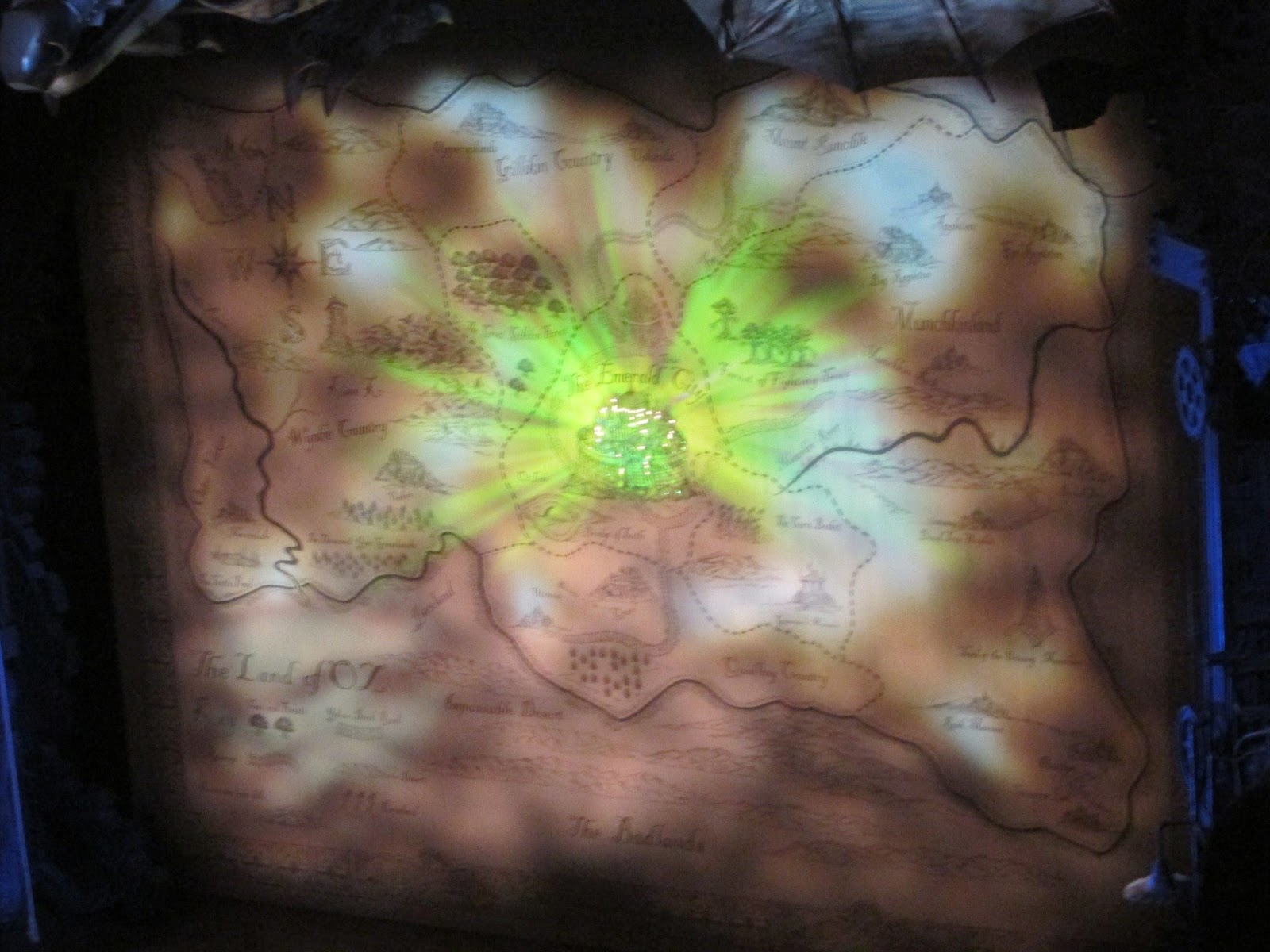
(Image: A map graphic, presumably of Oz complete with brown, blue green, and neon green lighting. This could be seen as part of the set design projected behind the stage.)
Curious, very curious.....
Trigger warning: description of sensory meltdown, cultural appropriation?, ableism
OK, so I just looked back at my journals and realized that this is slightly out of order, but I wanted to take a moment and continue this. Shortly before some of the adventures described in the last few posts, our group had the opportunity to see the second of five shows together, based on the well acclaimed children's book "The Curious Incident of the Dog in the Night-Time." Here is the part where I admit that I never actually read the book, so I had no idea what it was actually about (braces for audience heckling!) As the title may suggest, it is about the main character, Christopher, who has Asperger's and wants to solve the mystery of who stabbed his neighbor's dog.
Now before we even started the show, my friend and traveling companion wasted no time imparting on me how problematic it was that someone that had absolutely no experience with anybody who was Autistic, or on the spectrum in any way had even tried to write this play. That being said, I was pretty skeptical before watching the entire performance.
But I will agree that it was probably the best or second-best show out of 6 that I saw while there. Which led me to wonder if anyone's personal experiences were consulted during the staging of this play. From the backgrounds which had a lot to do with changing lighting effects, and simple set structures that could be repurposed in multiple ways, I actually felt like I was inside some of the experiences of a dear friend of mine as they were recounted firsthand. It was fascinating, intriguing, and at the same time incredibly disheartening when you realize as a viewer that this is still the way people are treated if society does not understand the way they communicate. There were several scenes in which the main character experienced sensory overload, which I felt was a parallel for what the audience was experiencing. I am not Autistic, but I do have a tendency to jump at loud noises or sudden changes in focus. And I have issues with sudden flashing of strobe lights. All of these things were used throughout the performance. So while I still agree that somehow this play re-created the experiences accurately and very well (at least for a certain group of people), and I say bravo to the cast and set designers for inhabiting that role, I couldn't help but sitting there thinking that my friend, who could be the first authority on how to accurately critique this performance, would have experienced such a sensory meltdown, that he would not have been able to sit through the show, or at the very least, may have been overwhelmed by the environment.
I will say that I really enjoyed this production, but it got me thinking about what is the paradox that occurs every time people's access needs conflict, which in a way, is a metaphor for this entire study abroad experience. I won't say it's for everyone, by any means, but if it works for you, this production is definitely worth the watch, if not for the questions it will bring about.
Until next time…
Sunday, August 23, 2015
A bill of rights as an autonomous disabled person
So let's take a trip to the present here for a little bit...
Many of you may know that I am now in the interesting phase of entering the real world, let alone now finally dealing with the systems in a city where I have completed my undergraduate career. For a person who has needed assistance from other people for most of my life, you would think I would have some idea how to do this process or at least how to get started. In the past, I have always been respected as a crucial member of a team that planned my care as soon as and possibly even before it was appropriate. As such, I am used to meeting with and coordinating with many different people so that I can go about my day as I need to. While I realize that this might be somewhat of a unique situation, I still amazed at the amount of stereotyping that goes into creating policies for people like myself, who wish to self direct their day but need assistance doing so. At this point I am trying to take the steps to have the most independent option possible but there are a lot of things that I found out do not go without saying in terms of how people interact with me every day.
Many of you may know that I am now in the interesting phase of entering the real world, let alone now finally dealing with the systems in a city where I have completed my undergraduate career. For a person who has needed assistance from other people for most of my life, you would think I would have some idea how to do this process or at least how to get started. In the past, I have always been respected as a crucial member of a team that planned my care as soon as and possibly even before it was appropriate. As such, I am used to meeting with and coordinating with many different people so that I can go about my day as I need to. While I realize that this might be somewhat of a unique situation, I still amazed at the amount of stereotyping that goes into creating policies for people like myself, who wish to self direct their day but need assistance doing so. At this point I am trying to take the steps to have the most independent option possible but there are a lot of things that I found out do not go without saying in terms of how people interact with me every day.
- None of my aides or caregivers need to be my parent, as much as they want to be.
- Even if someone does not agree with a decision that a disabled person is making, it doesn't mean that it's not their choice.
- While I realize there may be limitations on payment and billing of certain assistance services, this does not mean I cannot come and go as I please. My community involvement should not be restricted in any way because of the help I need. (I know there are people for whom this is not the case but if it is relatively simple for the person to leave their home, there's no reason why they should be restricted from doing so.)
- Somebody assisting another person doesn't need to add commentary on every individual task unless it's asked for.
- I have the right and legal authority to be a part of planning my own support. I should be treated as if I know what's best for me. I don't have a background in law but I know there are many of us who learn regulations out of necessity.
- I am a pretty laid back person in general, and I am pretty easy to get along with, so people are often surprised when I stand up for myself in terms of what I need. This needs to be commonplace and not unexpected.
- If I say that a solution does not work for me, people need to listen to that and respect that.
I don't understand why consumer directed support is not a universal thing and why it is so hard to set up. You'd think it would be the easiest thing to access as an alternative to a nursing facility. But somehow the people who know what they're doing always end up working for large companies that don't acually have a good reputation for client services, instead of allowing the client access to a large network of people with the credentials they need to help them. While I think it should definitely be considered as an option, it is definitely not the only option to go through an outside entity for management support as my personal experience and the experiences of many of my friends can attest to. Not only is the quality of client services severely impacted, but also the quality of the environment for the people who work there. Don't get me wrong, I've had some fantastic experiences, but largely I find that if you don't live with some type of disability you don't understand what it's like if somebody
forgets about you one day, or says there's nothing they can do for you. Now, imagine what that's like every day on and off for a month. This is not your Excel spreadsheet, these are our lives.
....and it's time we took them back!
Pastries, subways, and cab drivers. Or, adventures in Paris
I mentioned earlier that when I first returned from London, it was very hard for me to sum up the experiences I had in this part of the world. Nearly everybody I saw asked me “how was it?” “what was it like?”, or “what was your favorite part?” It took me a while to come up with experiences or funny stories that I could tell everyone about In a coherent set of words. If I talked to you, these adventures were probably among the stories I told you, so here goes, the legendary weekend trip to Paris…
As consistent with the theme here, we were once again left running for the mode of transportation, this time, the Eurostar train, this time by a communication failure not unlike one of those Bad Lip Reading videos, that was completely my fault. If you have not seen these, I think they are hilarious due to the sheer fact that these situations happened many times, most of which were incredibly hilarious. This one, however, was not, and led to me having a meltdown in the train station as they were calling our train for final boarding when we arrived. That aside, however, both of us calmed down when we were able to eat the croissants provided with the complimentary breakfast! Little did I know that this was only the first of the adventures to come.....
When we got to the Gare du Nord (the Northern Railroad Station for you non-francophones), I suggested we proceed to the information kiosk. I had the address and the reservation of the place we were going, but I was unable to get through to them on the phone beforehand as my international minutes did not work in the UK. So, I went to the ticket agent and asked her, in French, to please call the youth hostel so that I could confirm disability accommodations. As it turns out, there was no place on their website to specify this or make any comments. So the agent called them and she comes back asking me if I can walk upstairs at all, because there is somebody already staying in the accessible room. I said no, but then I thought the easiest thing to do would just be to sort this out when we get there, because of course no one knows what to do with a Deaf person and a person in a wheelchair when they see us together. So I asked for advice on the nearest transit location and we ended up waiting for about 45 min. extra than we were supposed to after finally finding the place when getting lost coming out of the station. At this point, both of us were so tired and hungry that we decided screw it, we're taking a cab.
So my friend and the cab driver folded up the chair just fine, but then the cab driver seemed concerned that my friend could not put me in the car somehow. He then decided that he and his brother, who was there for some reason, could do it better. So both of them picked me up and tried to shove me in the car fireman style without asking. Thankfully, I knew enough to tell them to stop, and tried to explain a better way to do it, or to just leave me alone, and let my friend do the job, but they wouldn't listen, and kept trying to force my legs in the back of the car, after I explained that they didn't bend so easily. After about the fifth time of trying to do this, they finally listened and let my friend put me in the car the easy way, all the time the meter was going up! At least I knew now that I could never be kidnapped easily, at least not in France.
When we got to the hostel, I thought, things had to start getting better. Firstst of all, these people didn't believe that it was even possible that I could have made all the reservations and all the card information etc. because I was in a wheelchair, so they kept trying to talk to my friend, who, of course, could not hear them well. The manager was mad because he had to keep opening the side entrance for me to get in and out, and he was also mad because he insisted on kicking two guests that weren't disabled out of our room, even though we said we didn't mind sharing, because it was a four-person room. Keep in mind that this entire time, I was speaking French like a duck with a nose plug.
After this was all sorted, as the Brits would say, the front desk was very nice to us. I wish I got the woman's name that worked there because she was such a pleasure to interact with and she was so helpful to both of us. She said that there were many options for transportation around there and told us where we could go and what to buy when we got there. The most interesting thing was that she complimented my fluency in French and said I spoke with a British accent, which is funny because out of respect for the culture, I had to try so hard not to do a British accent when I was there, but I quite enjoy doing it at home :-) This woman moved between French and English easily when talking to my friend, and when she noticed we were signing, she tried to teach us a few signs in LSF because she said she knew someone with a Deaf baby.
I remember when she informed us that the hostel Wi-Fi was not working (pronounced with a short I in French, that was fun to say!) So not only did we have phones that could not receive data and the minutes didn't work, we had no Internet either! What did people do before technology? I realized that I knew the general area my friends were staying in, but I didn't even have the address to snail mail them a letter. We had not seen anyone we knew all day, and could not contact the people we were supposed to be meeting up with to let them know we were okay. So, as we ventured out to try to find an Internet shop, which we discovered were all closed because France and nap time, we decided that we were going to eat pastries for dinner, so gosh darn it we did, and they were some of the best things I have ever eaten. Mine had pear flavored liqueur in it, and my friend got a lemon meringue. After the day we'd had, that was the best thing we could've asked for!
Instead of venturing out in the rain again, we decided to stay in and catch up on episodes of Switched at Birth that I had downloaded on my computer. There was so much to be said for the comforts of home at a time like that.
The next day, I knew that the group was going to meet at the Louvre on free day. So I decided that if we had any hope of salvaging this adventure, our best bet was to go there. After an interesting walk to find transportation that was not underground, we finally made it there. We realized that our group was nowhere to be found, and that it wasn't free day after all. So of course, what is the first thing we do? We have to go looking for internet. After looking at a few rooms and paintings, we find out that there is an apple store in the atrium of the Louvre. So here we are, we could be anywhere in the world seeing things that people have never seen, and we're in an apple store trying to use the internet.
So I was finally able to connect with my friend and he said everyone was meeting up at Notre Dame for the mass later that evening. I checked the transit schedule and realized that it was only about a 15 minute bus ride to L'Institut National des Jeunes Sourdes - AKA St. Jacques. This was the school where the founder of American Deaf culture, Laurent Clerc, went to school and it ws the first school where manual sign language was used as the primary method of instruction for deaf students. As some European travelers may know, a lot of the streets in France have circular intersections with different branches. So when I kept asking for directions and the guy would say 'go straight' I didn't know what he meant because there were too many options. We had no GPS but I found out later that we were only 500 yards from the school itself but we were so lost and I was so upset that we decided not to continue.
We ended up making our way back to Notre Dame to meet up with the rest of our group. By the end of this ordeal I was so happy to see people I actually knew besides my friend. They didn't know we had made it there and wanted to know where we'd been the entire time. They expained that they could use my interpretation skills to order food so we decided to go to a meal together where I could tell everyone what they were reading on the menu. Like any true traveler would I ordered des cuisses de grenouille (that's frog legs for you Americans). It's true, they do taste just like chicken. Maybe I'm weird but I love foie gras which is paté made out of goose liver, and you can spread it on toast - it's amazing!
We ended up cruising the markets and the bookstores, including a really well known one called Shakespeare and Company. While some people opted to climb the Eiffel Tower, I was obviously not that interested as the elevator only goes to the second deck. So instead, another group member had the idea to go to L'Arc de Trionphe on the Métro, which is awful for wheelchair users. So once again this ended up being an adventure of carrying me down a flight of stairs. I was able to recruit a very good looking French passer-by and explain to him how to lift the wheelchair and help us down. While there, my friend told us that the Eiffel Tower lights up every night at midnight, so we decided to stay up and watch the sparkle.
The next morning we made our way back on the Eurostar on our own, in just enough time to have our classmates to have security problems and have our train get stuck in the chunnel. So for all this concern about being on time, there was nothing I could do about the 2 hour delay back to class except to take a nap. Somehow our professor did not seem surprised.
Until tomorrow...


(Image: Two pastries in a box. The one on the left has lemon meringue with circles of whipped cream and designs on the top. The one on the right is a pear tart with what looks like a cursive letter 'H' on top.)
 (Image: A view of the palace outside of the Louvre on a rainy day. A palace is visible along with a ferris wheel on a slight angle.)
As consistent with the theme here, we were once again left running for the mode of transportation, this time, the Eurostar train, this time by a communication failure not unlike one of those Bad Lip Reading videos, that was completely my fault. If you have not seen these, I think they are hilarious due to the sheer fact that these situations happened many times, most of which were incredibly hilarious. This one, however, was not, and led to me having a meltdown in the train station as they were calling our train for final boarding when we arrived. That aside, however, both of us calmed down when we were able to eat the croissants provided with the complimentary breakfast! Little did I know that this was only the first of the adventures to come.....
When we got to the Gare du Nord (the Northern Railroad Station for you non-francophones), I suggested we proceed to the information kiosk. I had the address and the reservation of the place we were going, but I was unable to get through to them on the phone beforehand as my international minutes did not work in the UK. So, I went to the ticket agent and asked her, in French, to please call the youth hostel so that I could confirm disability accommodations. As it turns out, there was no place on their website to specify this or make any comments. So the agent called them and she comes back asking me if I can walk upstairs at all, because there is somebody already staying in the accessible room. I said no, but then I thought the easiest thing to do would just be to sort this out when we get there, because of course no one knows what to do with a Deaf person and a person in a wheelchair when they see us together. So I asked for advice on the nearest transit location and we ended up waiting for about 45 min. extra than we were supposed to after finally finding the place when getting lost coming out of the station. At this point, both of us were so tired and hungry that we decided screw it, we're taking a cab.
So my friend and the cab driver folded up the chair just fine, but then the cab driver seemed concerned that my friend could not put me in the car somehow. He then decided that he and his brother, who was there for some reason, could do it better. So both of them picked me up and tried to shove me in the car fireman style without asking. Thankfully, I knew enough to tell them to stop, and tried to explain a better way to do it, or to just leave me alone, and let my friend do the job, but they wouldn't listen, and kept trying to force my legs in the back of the car, after I explained that they didn't bend so easily. After about the fifth time of trying to do this, they finally listened and let my friend put me in the car the easy way, all the time the meter was going up! At least I knew now that I could never be kidnapped easily, at least not in France.
When we got to the hostel, I thought, things had to start getting better. Firstst of all, these people didn't believe that it was even possible that I could have made all the reservations and all the card information etc. because I was in a wheelchair, so they kept trying to talk to my friend, who, of course, could not hear them well. The manager was mad because he had to keep opening the side entrance for me to get in and out, and he was also mad because he insisted on kicking two guests that weren't disabled out of our room, even though we said we didn't mind sharing, because it was a four-person room. Keep in mind that this entire time, I was speaking French like a duck with a nose plug.
After this was all sorted, as the Brits would say, the front desk was very nice to us. I wish I got the woman's name that worked there because she was such a pleasure to interact with and she was so helpful to both of us. She said that there were many options for transportation around there and told us where we could go and what to buy when we got there. The most interesting thing was that she complimented my fluency in French and said I spoke with a British accent, which is funny because out of respect for the culture, I had to try so hard not to do a British accent when I was there, but I quite enjoy doing it at home :-) This woman moved between French and English easily when talking to my friend, and when she noticed we were signing, she tried to teach us a few signs in LSF because she said she knew someone with a Deaf baby.
I remember when she informed us that the hostel Wi-Fi was not working (pronounced with a short I in French, that was fun to say!) So not only did we have phones that could not receive data and the minutes didn't work, we had no Internet either! What did people do before technology? I realized that I knew the general area my friends were staying in, but I didn't even have the address to snail mail them a letter. We had not seen anyone we knew all day, and could not contact the people we were supposed to be meeting up with to let them know we were okay. So, as we ventured out to try to find an Internet shop, which we discovered were all closed because France and nap time, we decided that we were going to eat pastries for dinner, so gosh darn it we did, and they were some of the best things I have ever eaten. Mine had pear flavored liqueur in it, and my friend got a lemon meringue. After the day we'd had, that was the best thing we could've asked for!
Instead of venturing out in the rain again, we decided to stay in and catch up on episodes of Switched at Birth that I had downloaded on my computer. There was so much to be said for the comforts of home at a time like that.
The next day, I knew that the group was going to meet at the Louvre on free day. So I decided that if we had any hope of salvaging this adventure, our best bet was to go there. After an interesting walk to find transportation that was not underground, we finally made it there. We realized that our group was nowhere to be found, and that it wasn't free day after all. So of course, what is the first thing we do? We have to go looking for internet. After looking at a few rooms and paintings, we find out that there is an apple store in the atrium of the Louvre. So here we are, we could be anywhere in the world seeing things that people have never seen, and we're in an apple store trying to use the internet.
So I was finally able to connect with my friend and he said everyone was meeting up at Notre Dame for the mass later that evening. I checked the transit schedule and realized that it was only about a 15 minute bus ride to L'Institut National des Jeunes Sourdes - AKA St. Jacques. This was the school where the founder of American Deaf culture, Laurent Clerc, went to school and it ws the first school where manual sign language was used as the primary method of instruction for deaf students. As some European travelers may know, a lot of the streets in France have circular intersections with different branches. So when I kept asking for directions and the guy would say 'go straight' I didn't know what he meant because there were too many options. We had no GPS but I found out later that we were only 500 yards from the school itself but we were so lost and I was so upset that we decided not to continue.
We ended up making our way back to Notre Dame to meet up with the rest of our group. By the end of this ordeal I was so happy to see people I actually knew besides my friend. They didn't know we had made it there and wanted to know where we'd been the entire time. They expained that they could use my interpretation skills to order food so we decided to go to a meal together where I could tell everyone what they were reading on the menu. Like any true traveler would I ordered des cuisses de grenouille (that's frog legs for you Americans). It's true, they do taste just like chicken. Maybe I'm weird but I love foie gras which is paté made out of goose liver, and you can spread it on toast - it's amazing!
We ended up cruising the markets and the bookstores, including a really well known one called Shakespeare and Company. While some people opted to climb the Eiffel Tower, I was obviously not that interested as the elevator only goes to the second deck. So instead, another group member had the idea to go to L'Arc de Trionphe on the Métro, which is awful for wheelchair users. So once again this ended up being an adventure of carrying me down a flight of stairs. I was able to recruit a very good looking French passer-by and explain to him how to lift the wheelchair and help us down. While there, my friend told us that the Eiffel Tower lights up every night at midnight, so we decided to stay up and watch the sparkle.
The next morning we made our way back on the Eurostar on our own, in just enough time to have our classmates to have security problems and have our train get stuck in the chunnel. So for all this concern about being on time, there was nothing I could do about the 2 hour delay back to class except to take a nap. Somehow our professor did not seem surprised.
Until tomorrow...

(Image: Me sitting in front of the Arc de Triomphe with my arm outstretched like I'm trying to be Vanna White. The picture was taken at night and I am sitting in my chair wearing a striped tank top and shorts)

(Image: Two pastries in a box. The one on the left has lemon meringue with circles of whipped cream and designs on the top. The one on the right is a pear tart with what looks like a cursive letter 'H' on top.)

Subscribe to:
Posts (Atom)